Occupational safety and health legislative framework
In Finland, public administration is required by the law to protect the labour force. The European framework Council Directive 89/391/EEC [1] is transposed into Finnish law by the Occupational Safety and Health Act (738/2002) [2] and the Act on Occupational Health Services (1383/2001) [3].
The Occupational Safety and Health Act (738/2002)[2] applies to all paid employment and stipulates the minimum level of safety and health at work. The Act also describes the responsibilities of employers and employees, and the co-operation of employers and employees required to promote occupational safety and health.
The Occupational Health Care Act (1383/2001) [3] applies to all employment under which the employer is bound by the Occupational Safety and Health Act [2]. The Occupational Health Care Act [3] requires employers to organize and pay for the preventive services for all employees regardless of the size, form of the organization of enterprise or industrial sector covering both public and private sectors. However, organization of occupational health care services is voluntary for self-employed persons and entrepreneurs. Employers may organize occupational health services themselves or through public occupational health care centres or private service providers. The responsibility for organizing health, social and rescue services was transferred from municipalities to larger wellbeing services counties in the beginning of 2023[4a][4b].) According to the Occupational Health Care Act [3] the content of occupational health services is primarily preventive. The organization of curative services, such as medical treatment of diseases and general preventive health services, is voluntary. Each employer is required to describe the organization and content of the services in a company-wide plan.
The Act on Occupational Safety and Health Enforcement and Cooperation on Occupational Safety and Health at Workplaces (44/2006)[6];
Government Decree on the principles of good occupational health care practice, the content of occupational health care and the qualifications of professionals and experts (708/2013) [7];
Government Decree on medical examinations in work that presents a special risk of illness (1485/2001)[8].
National strategy and programmes
Details on the national OSH strategy and strategic documents can be found in a specific OSHwiki article
Social dialogue
According to an Eurofound study on Working conditions and Social Dialogue in Finland [18], the Finnish social dialogue concerning working conditions is a natural part of the activities of the social partners. Finland has a long tradition of systematically agreeing national income policies, which has also significantly influenced the social dialogue on OSH matters. The Finnish dialogue is characterized by openness in discussing and handling disagreements, but also by the goal of identifying some kind of common ground between the social partners.
The Finnish work life is based on the principle of tripartite collaboration between the government, the employers and the employees. All the key policies related to work life, occupational safety and health, social security and the labour market are negotiated collectively between the three partners (government, employers and trade unions) and agreements are signed on a consensual basis.
Policy Advisory Committees have representations from all the relevant administrative sectors, i.e. employers and trade unions, professional associations and other non-governmental organizations (NGOs). The Advisory Committees are legislation-based and they have a recognized official status. The Advisory Committee on Occupational Safety and Health is located within the jurisdiction of the Ministry of Social Affairs and Health. It is appointed by Finland’s Council of State (Valtioneuvosto, Statsråd). The members of the Committee are appointed to represent the most significant organizations of the social partners as well as other important stakeholders in the development of OSH [19].
Social dialogue at national level
At the national level the coordination of policies and activities takes place in ministerial groups (government level). The ministers of neighboring sectors are expected to coordinate their policies:
The Ministry of Social Affairs and Health[9] acts in conjunction with the Advisory Committee on Occupational Safety and Health in which the labour market parties are represented. All the key policies related to occupational safety and health are negotiated collectively between the three partners (Government, Employers and Trade Unions). The agreements are usually signed on a consensual basis.
There are also other Advisory Committees relevant to OSH in the Finnish Government Administration, e.g. the Advisory Committee on Occupational Health Services, which is located within the Ministry of Social Affairs and Health[9].
The social partners include:
The Confederation of Finnish Industries (Elinkeinoelämän keskusliitto, EK; Finlands Näringsliv) is the leading business organization in Finland. It represents the entire private sector, both industry and services, and companies of all sizes [20].
Local Government and County Employers (Kunta- ja hyvinvointialuetyönantajat, KT; Kommun- och välfärdsåmrodesarbetsgivarna) serves as the employers’ federation and national confederation for the local government sector, negotiating collective agreements for local government officials on behalf of local authorities and local government federations [21].
The State Employer's Office (Valtion työmarkkinalaitos, VTML; Statens arbetsmarknadsverk) undertakes collective agreements for employees and civil servants employed by the state [22].
The Labour Market Organisation of the Church (Kirkon Työmarkkinalaitos, KiT; Kyrkans arbetsmarknandsverk) serves as the employer’s representative in concluding collective agreements on behalf of the Evangelical-Lutheran Church and its parishes and parish federations, and also represents the ecclesiastical employer in labour market policy lobbying [23].
The Central Organization of Finnish Trade Unions (Suomen Ammattiliittojen Keskusjärjestö, SAK; Finlands Fackförbunds Centralorganisation, FFC) is a confederation of 20 trade unions in industry, the public sector, transport and private services [24].
The Finnish Confederation of Professionals (Toimihenkilökeskusjärjestö, STTK; Tjänstemanncentralorganisationen) is one of the three trade union confederations in Finland [25].
The Confederation of Unions for Academic Professionals (Akateemisten keskusjärjestö, AKAVA; Centralorganisationen för högutbildade i Finland) is a trade union confederation and represents employees with university-level, professional or other high-level training [26].
Social dialogue at sectoral level
In Finland there are four sector groups (Industrial Group, Transport and Logistics Group, Private Service Sector Group, and Local Public Sector Group) and 21 Safety Branch Committees in which different branches act in co-operation with the Centre for Occupational Safety (Työturvallisuuskeskus, TTK; Arbetarskyddscentralen)[27]. The sector groups and the occupational safety committees carry out campaigns and plan publishing activities and training courses. The labour market organizations are represented in the sector groups and the occupational safety committees.
Social dialogue at enterprise level
The national Occupational Safety and Health Act (738/2002)[2] stipulates that the employers and employees shall cooperate in improving and maintaining safety in the workplaces. OSH matters are discussed between the employer, the employees or their representatives.
The Occupational Safety and Health Committees must be organized in workplaces with 20 or more employees. The Committee represents the main forum for collaboration at the enterprise and workplace level between workers and employers on OSH issues.
OSH infrastructure
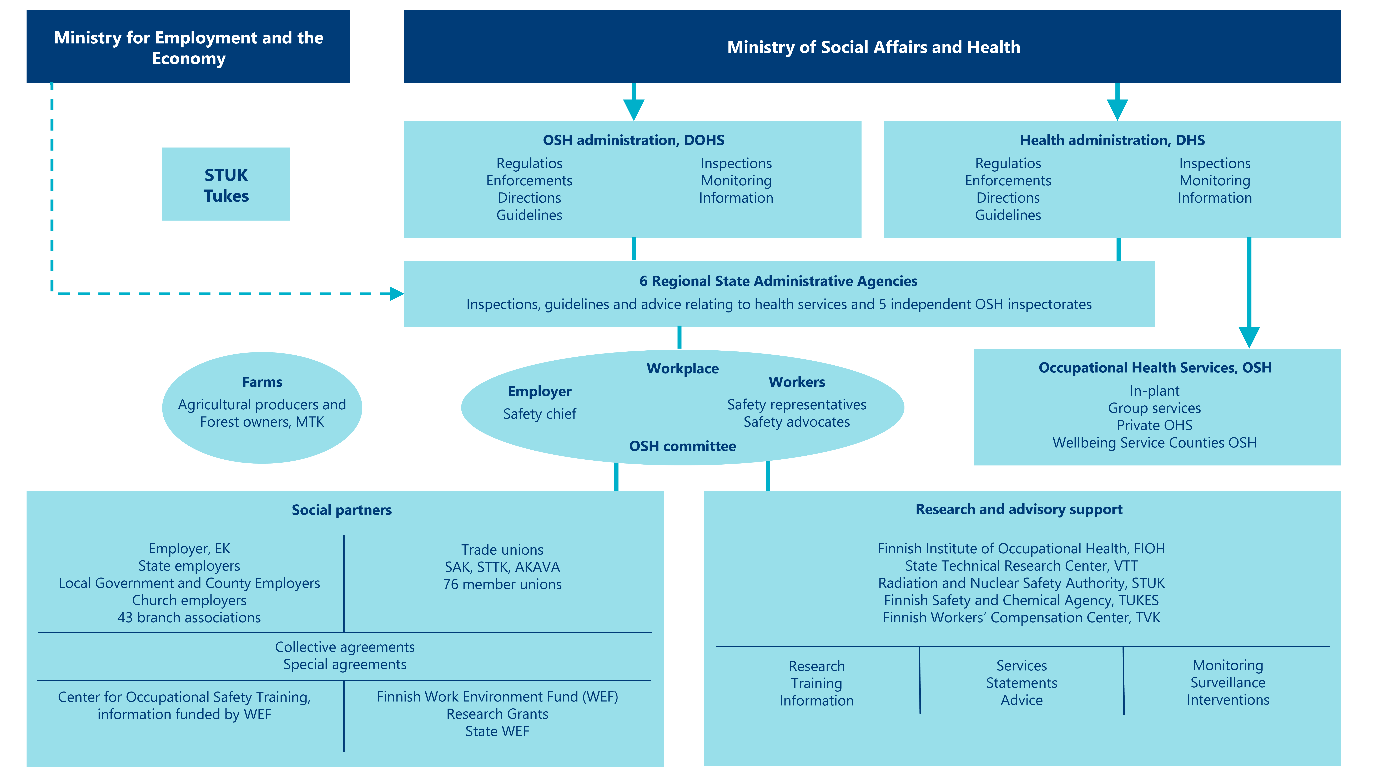
OSH infrastructure scheme
Figure 1: The OSH infrastructure in Finland Source: Adapted by the authors on 2023 from Finland's country report at NDPHS (SIHLWA) [29]
National competent bodies
OSH authorities and inspection services
In Finland the Ministry of Social Affairs and Health [9] is responsible for the preparation of OSH legislation, the enforcement and development of OSH, statutory insurance, gender equality and the development of occupational health care. This Ministry works closely with other ministries on any matters that may be related to OSH.
The Department for Work and Gender Equality is responsible for the development of national occupational safety and health policies, the coordination of research in occupational safety and health issues, and the efficient application of research information.
One of the main tasks of the Ministry of Economic Affairs and Employment is to smooth out difficulties in the operation of the labour market and work organization. It prepares essential labour legislation together with the labour market organizations.
The Department for Work and Gender Equality with the Ministry of Social Affairs and Health[9] is the highest Government body for OSH Administration and it supervises independent Labour Inspectorates. Finland is divided into six independent Occupational Safety and Health Inspectorates (Regional State Administrative Agencies; Aluehallintovirasto, AVI; Regionförvaltningsverket) [12]. The responsibilities and rights of the OSH authorities are described in the Act on Occupational Safety and Health Enforcement and Cooperation on Occupational Safety and Health at Workplaces (44/2006) [6]. The Act on Occupational Safety and Health Administration (16/1993) [19] defines the tasks to be undertaken by the occupational safety and health authorities.
The Inspectorates [12] provide instructions and advice on applying the regulations on occupational safety and health matters, working conditions, employment and equality, and ensures that there is adherence to these regulations and guidelines in the workplaces.
The OSH authorities need to monitor compliance with more than 100 items of legislation. The most important of these legislative acts are the Occupational Safety and Health Act [2] and the Decrees based upon it, the Occupational Health Care Act[3], the Employment Contracts Act, the Working Hours Act [31], the Annual Holidays Act [32] and the Young Workers’ Protection Act [33]. The OSH authorities also investigate serious occupational accidents and major cases of occupational diseases.
The occupational safety and health inspectors (Regional State Administrative Agencies)[12] supervise approximately 240,000 workplaces, in which almost 30,000 inspections are carried out annually. Another part of OSH enforcement is market surveillance. Market surveillance includes monitoring of the compliance with legislation on products on the market.
Physicians who diagnose occupational or work-related diseases are obliged by the Act on Occupational Safety and Health Enforcement and Cooperation on Workplace Safety and Health (44/2006)[6] to report these cases to the OSH inspection.
Other occupational safety and health authorities include Finnish Safety and Chemicals Agency Tukes (Turvallisuus- ja kemikaalivirasto, Tukes; Säkerhets- och kemikalieverket)[34], Radiation and Nuclear Safety Authority (Säteilyturvakeskus, STUK; Strålsäkerhetscentralen)[36], and the Finnish Transport and Communication Agency (Liikenne- ja viestintävirasto, Traficom; Transport- och kommunikationsverket)[37]. OSH is supported also by the National Supervisory Authority for Welfare and Health (Sosiaali- ja terveysalan lupa- ja valvontavirasto, Valvira; Tillstånds- och tillsynsverket för social- och hälsovärd)[38a].
OSH services
Internal OSH services
The employer is responsible for occupational safety and health measures in the workplace. The Finnish OSH policies have a sound foundation built on collaboration at the workplace level between employers, workers and other actors. The Occupational Safety and Health Act (738/2002)[2] creates the legal framework and stipulates the obligations and rights of the employers, workers and authorities with respect to safety and health at work. When defining the content and extent of OSH activities, the employer must recognize aspects of work, working conditions, and the work environment. They are responsible for:
Controlling hazards at their source;
Eliminating hazards and when this is not possible, minimizing them or substituting with less hazardous means;
Arranging collective safety measures – ahead of individual-based procedures;
Evaluating the effectiveness of the health and safety measures undertaken;
Continuously following-up and monitoring working conditions.
The Act on Occupational Safety and Health Enforcement and Cooperation on Workplace Safety and Health (44/2006)[6] describes the tasks, rights and obligations with respect to OSH of the employers, workers, safety managers, safety representatives of the workers, and the workplace Occupational Safety and Health Committee (OSH Committee). Each employer has to have a safety manager who is the employer's representative in safety and health matters. There are no official requirements about the training of the safety manager. The employer appoints the safety manager or the employer may act himself/herself as a safety manager. The employer has the duty to continuously monitor the safety of the work environment, the work atmosphere and the work practices and to take necessary remedial action. Monitoring must not be based solely upon employee reports. The employer must tell the reporting employee and the OSH representative what action has been taken or will be taken in the reported matter. If the employer considers that the report does not require any action, this information should also be told to the employee to avoid confusion.
Safety representatives must be elected by the workers in all workplaces employing 10 or more persons. The safety representative represents the employees in the workplace OSH cooperation. The employees may elect a safety representative separately for the workers, salaried employees and upper white-collar employees, or a there can be a single representative representing all employees in that workplace. The safety representative has the right to access all the documents on health and safety, which the employer must maintain by law. In addition, every workplace with 20 employees or more needs to establish an OSH Committee for the representation of workers, salaried employees and the employer.
External OSH services
Employers may outsource occupational health care services to a public occupational health centre or a publicly owned OHS company or organize the services either by themselves or in cooperation with other employers, or outsource the services to a private occupational health care service provider (medical centre). In 2015 42% of businesses and 29% of employees used the occupational health care services of public health centres or public OHS companies. In contrast, 54% of businesses and 58% of employees used the services of private medical centres. In 2018 the percentage of business and employees using services of private medical services had risen to 71%, and in contrast the use of public occupational health centres had fallen. In 2015, 23% of the Finnish OHS units were municipal (health center or municipal company), 6% in-plant or joint clinics of the employers, and 52% were OHS units in private medical centres. In 2018 the number of organizations providing occupational health services has remined more or less the same as in previous years. The percentage of private medical centers being the providers of occupational health care had risen to about 70% in 2018. In 2015 84% of the employed labour force in Finland was covered by occupational health care. The organization of curative services is voluntary, however 90% of workers who have occupational health services have also access to curative services. In 2018 the percentage of using curative services had fallen to 71%. However, the coverage of occupational health services of the employed labour force has remained in 2018 the same as in previous years. [38b] In the beginning of 2023 the municipal public health care services were rearranged into larger wellbeing services counties care units providing for several municipalities [4a]. The wellbeing services counties are responsible for ensuring OH services are available within their area [4c][4c].
External service for technical control
The duties of inspection bodies include evaluation of the deployment and operation of equipment and systems, and the assessment of the competence of individuals and organiz ations. The activities of these bodies are based on national legislation for each industrial sector. The clients are operators or private individuals using the services of the inspection body. Clients may in turn employ supervisors, as required under the law, to be in charge of monitoring specific work processes.
Finnish Safety and Chemicals Agency (Tukes)[34] monitors the standard of inspection bodies’ activities through periodic assessments: (1) by monitoring the practical inspection work in connection with client control visits, (2) by monitoring the inspection body’s inspection reports, and (3) on the basis of notifications from clients and competitors. Additionally, the inspection body is required to be skilled, technically competent and independent in its work.
Finnish Accreditation Service (FINAS)[35] acts as an outside assessor of inspection bodies. FINAS operates as a unit within the Finnish Safety and Chemicals Agency, Tukes.[34]Assessments are used to ensure that the inspection body meets the competence criteria. The methods of assessment are (1) accreditation or (2) issuing separate statements. The assessment procedure is related both to the approval stage and the assessment conducted during operations.
Compensation and insurance bodies
In Finland, the employer is responsible for insuring employees against occupational accidents and occupational diseases as defined by Workers’ Compensation Act 459/2015[39]. There is a corresponding legislation for agricultural entrepreneurs (1026/1981[40]; last amendment 1274/2016 [41]). Other self-employed persons can arrange the accident insurance on a voluntary basis. The national accident insurance legislation defines the relevant compensation.
Workers’ Compensation Act 459/2015 [39] defines the criteria for an occupational disease. An Occupational Disease is defined as a disease caused by physical, chemical or biological factor at work or by physical overload or poor ergonomics (e.g. repetitive strain). Governmental Decree on the Ordinance on Occupational Diseases (769/2015)[42] contains a list of physical, chemical and biological factors and the diseases that may be caused by these factors, which are mostly based on epidemiological or clinical evidence. The list is not exhaustive, for example, factors or diseases not on the list can also be suspected and recognized as causing or being an OD if a causal relationship between the exposure and the disease can be proved in an individual case, as in many respiratory and skin allergies determined by provocation or skin tests.[43]
In Finland, occupational accident insurance is offered by 12 private accident insurance companies under the supervision of the Ministry of Social Affairs and Health[9]. The accident insurance system is financed through premiums paid by the employers. Worker´ Compensation center (Tapaturmavakuutuskeskus, TVK)[45] coordinates the statutory accident insurance. The TVK is a liaison organization for the insurance companies. It combines statistics on occupational accidents and diseases together with their causes and consequences and helps prevent these in the future. An occupational safety and health committee, with representatives from the social partners and the insurance sector, directs TVK’s OSH activities and co-ordinates the insurance sector. In addition, TVK investigates fatal occupational injuries. These are examined by an investigation board which has representatives from the central labour market organizations, insurance companies and the Centre for Occupational Safety (Työturvallisuuskeskus, TTK; Arbetarskyddscentralen)[27].
According to the Health Insurance Act (1224/2004)[46] employers are entitled to reimbursement from the Social Insurance Institution of Finland (KELA, FPA), [47] to compensate for 60 % for preventive occupational health care and 50 % for voluntary medical/curative care, in both cases calculated on the basis of necessary and reasonable costs. KELA each year calculates a maximum reimbursement rate for both categories (preventive and curative care). KELA pays sickness allowance as compensation for loss of earnings caused by an illness after a 10-day waiting period.
Other OSH bodies
Prevention Institutes
In Finland, prevention and preventive actions[3] are included in all activities for maintaining and improving safety and health at work. Therefore there are no specific organizations handling only preventive activities, instead all OSH actors carry out preventive activities.
Professional associations
Finnish Association of Occupational Health Physicians (Suomen Työterveyslääkäriyhdistys ry., STLY; Finlands Företagsläkarförening rf.)[48] The Association (STLY) aims:
To promote occupational health care in all sectors of employment;
To improve members' professional skills and promote ethical practices;
To promote members' work ability and well-being;
To co-operate with all actors endeavoring to enhance and support Finnish occupational health care;
To support research on occupational health care.
The Finnish Association of Occupational Health Nurses (FAOHN) (Suomen Työterveyshoitajaliitto ry., STTHL; Finlands Företagshälsovårdareförbund)[49] The goals of the Association (FAOHN) are to develop occupational health nursing as a profession, and to promote the employment of these nurses. FAOHN promotes health care services for the working population, carries out information and publishing activities, and participates in international collaboration as ways to develop occupational health.
Association of Finnish Physiotherapists in Occupational Health ((Työfysioterapeutit ry.; Finlands Företagsfysioterapeuter)[50] The Association aims:
To support physiotherapists working in the occupational health care sector and to enhance their professional skills;
To communicate issues related to professional expertise;
Collaboration between research centres and educational institutes;
Inter-professional collaboration with other well-being service providers;
To follow and influence the legislation and changes in society in relation to physiotherapists’ work in occupational health.
Association of Finnish Safety Managers (Finnsafe).[51] Finnsafe aims to:
Promote workplace safety and wellbeing, and improve the working environment;
Increase its members’ knowledge about workplace safety, wellbeing and the working environment;
Provide its members in Finland and abroad with relevant information on the subject;
Create training and educational opportunities for its members;
Act as a professional organization and to represent its members, i.e. by issuing statements on relevant issues.
Finnish Occupational Hygiene Society (FOHS) (Suomen Työhygienian seura; STSH)[52] FOHS improves the level of knowledge and professional skills of individuals working in the field of the occupational hygiene.
Finnish Ergophthalmological Society (Suomen Työnäköseura ry.)[53] The Society aims to promote and bring into practice research on ophthalmology at work and to increase and deliver knowledge on ergophtalmology in co-operation with other stakeholders.
Finnish Work Safety Association (Suomen Työturvallisuuden Liitto STYL ry). STYL aims to improve safety at work through high quality trainings and products through competent sales personnel.[54]
The Finnish Psychological Association (Suomen Psykologiliitto). The Association is trade union for psychologists and it advocates for the professional, financial and social benefits for Finnish psychologists. It provides information on training to psychologists and on working as psychologist in Finland. [87]
Education and training and awareness raising
Legally required training for OSH specialists
The training of occupational health and safety professionals and experts in Finland is regulated by the Occupational Health Care Act (1383/2001)[3] and the Government Decree (708/2013) [55].
Occupational health care professionals and experts competence requirements
A full-time (more than 20 hours a week) occupational physician should be a specialist in occupational health care. The basic training for physicians takes six years, and the specialization studies for occupational health physician requires an additional six years. The requirements to act as a specializing physician are covered by the separate provisions in the Decree of the qualifications of specialist physicians (56/2015)[56] and modifications to it on 2020[57] A licensed physician working part-time (less than 20 hours a week) in occupational health care (OHC) must have taken a minimum fifteen credits (ECTS) in OHC studies within two years of transferring to OHC.
A licensed public health nurse working full-time in OHC needs to be a qualified public health nurse and must have taken a minimum of fifteen credits (ECTS) in OHC studies within two years of transferring to OHC.
A licensed physiotherapist working in OHC needs to be qualified as a licensed physiotherapist must have taken a minimum fifteen credits (ECTS) in OHC studies within two years of starting the OHC activities.[58]
A licensed psychologist working in OHC must be qualified as licensed psychologist and must have passed the specialist studies in OHC needs to have a minimum of fifteen credits (ECTS) in OHC studies within two years of starting the expert activities.
The other experts, i.e. occupational hygienist, expert in social work, technical expert, agricultural advisor, optician, dietician, speech therapist, physical educator, etc. working in OHC need to have the relevant university degree in occupational hygiene, social work, a technical subject, agriculture, occupational vision, nutrition, speech therapy or physical education, or the equivalent earlier vocational qualification in the field, and sufficient knowledge of OHC. In effect, this means a minimum of two credits (ECTS) of supplementary training in OHC. Expert in OHC is also a physician, who has specialized in other medical specialty than OHC (555/2021)[59].
The Finnish Institute of Occupational Health (FIOH) [60] offers a multiprofessional training for qualification in OHC of fifteen credits (ECTS) to licensed physicians, public health nurses, physiotherapists and psychologists.
Polytechnics offer a qualification in OHC of fifteen credits (ECTS) to licensed public health nurses and physiotherapists. Universities also offer a qualification in OHC (twenty credits ECTS) to licensed psychologists as a part of specialist psychology training.
The Finnish Institute of Occupational Health (FIOH) [60] and polytechnics have a common curriculum. It is based on the aims of Occupational Health Care Act (1383/2001)[3]:
Working life and the operational environment of occupational health services (2 credits)
Identifying and evaluating work-related health risks and harms, strain factors and resources involved in the work (5 credits)
Supporting health, functional capacity and working ability (5 credits)
Evaluation and development of occupational health collaboration (3 credits)
The Finnish Institute of Occupational Health (FIOH) offers a qualification in OHC of two credits (ECTS) to above mentioned experts.
Occupational safety and health manager and representatives competence requirements
According to the Act on Occupational Safety and Health Enforcement and Cooperation on Occupational Safety and Health at Workplaces (44/2006)[6] the occupational safety and health manager needs to be adequately qualified on the nature of the workplace, the work conditions, and the OSH provisions, but no specific formal training is required. The Finnish OSH legislation requires that the safety manager must be “sufficiently competent”. However, the legislation does not state how one should acquire this competence. There is no formal description, e.g. there are no detailed requirements concerning the length and the content of the necessary training of occupational safety and health managers. The same applies for the safety representatives, they have a statutory right to training, but there is no formal description regarding length and content of such a training.
The Finnish Institute of Occupational Health[60] offers four (4) week training courses to occupational safety and health managers which cover all necessary topics to reach the required competency. These topics are:
These topics are:
targets of OSH at workplace;
OSH legislation and agreements;
tasks and duties and responsibilities in the workplace;
OSH cooperation in the workplace;
information sources, research and advisory bodies;
accident prevention;
preventive methods;
working ability and well-being;
ergonomics;
work hygiene; physical and chemical agents in the workplace;
psycho-social work environment;
safety management, quality.
Teaching methods are multidisciplinary and include practical tasks and exercises. The participants must pass an examination at the end of course after which, they will receive a certification.
The occupational safety and health representative and the vice-representative (elected by the workers) need to receive appropriate training for carrying out their co-operational duties. Prior experience and any earlier training in OSH matters are taken into account when planning the training. This training covers provisions and instructions on OSH, as well as other matters within the representatives' duties such as evaluation of working conditions and planning preventive OSH actions. The curriculum is planned by the organizers of the training courses (for instance FIOH[60], Centre for Occupational Safety [27], MIF [61], Pohto [62]). The law states that safety representatives must have a “appropriate training according to their occupational safety tasks”. The length of that training varies between 3-5 days and covers many topics such as
tasks and duties of safety representative
OSH co-operation at workplace
aims of OSH
working conditions and health
OSH legislation
occupational health care
OSH prevention methods.
The employer and the representatives are required to evaluate the need for training and to undertake the arrangements within two months of the election. The training needs to be free of any costs and not to involve any loss of income to the representatives.
Other vocational training
The Finnish Institute of Occupational Health (FIOH) (Työterveyslaitos, TTL; Arbetshälsoinstitutet) [60] and the Centre for Occupational Safety (Työturvallisuuskeskus, TTK; Arbetarskyddscentralen)[27] offer basic and advanced courses in occupational safety and health for safety managers and safety representatives.
The Trade Unions' Central Organizations (SAK, FFC)[24] and individual Trade Unions, as well as the Finnish Confederation of Professionals (STTK)[25]and the Confederation of Unions of Academic Professionals (AKAVA)[26]have an agreement with the Confederation of Finnish Industries EK (i.e. private employers)[20], the State Employer's Office (i.e. governmental employers) [22]and the Local Government and County Employers KT [21] about training in OSH. The training institutes of the Trade Unions provide three types of OSH courses: basic courses in OSH, advanced courses, and complementary courses. The training is targeted mainly at the safety and health representatives and their substitutes, as well as at the members of Occupational Safety and Health Committees.
The Management Institute of Finland, MIF [61] (established in July 2012) provide courses in OSH for technical personnel and for managers and supervisors. The Institute also provides services for organizational development and for leadership development. Pohto [62] is a training and development centre which organizes a variety of courses including training in occupational safety and health matters.
A large number of organizations provide Occupational Safety Card Training [63] which provides basic information on occupational health and safety. The "Card" is operated by the Centre for Occupational Safety [27]. It is awarded after a one-day introductory training session on safety and health, and it is granted for a five-year period. The Card is designed especially for workers at certain worksites, for example large construction sites, that are shared by several enterprises and different employers operating in the same site.
Awareness raising networks
Four organizations have a special mission to promote the dissemination of information in the field of occupational safety and health:
The Department for Work and Gender Equality within the Ministry of Social Affairs and Health [9];
Finnish Institute of Occupational Health (FIOH) hosts the Focal Point of the European Agency for Health and Safety at Work [65]. The Focal Point coordinates the national activities of the EU-OSHA's occupational health and safety network.
The Finnish Institute of Occupational Health[60] disseminates information through several channels: Web service and social media (for example, YouTube (@Tyoterveyslaitos) information sharing covers multidisciplinary topics such as safety, work ability, occupational health services, ergonomics, mental health at work, chemical safety, etc. FIOH publishes of its own web journal Työpiste. In addition, each year FIOH's research projects result in around 200 published scientific publications . FIOH disseminates the latest and updated information on Finnish work-life on a web platform "Work-life knowledge service". The Scandinavian Journal of Work Environment and Health (SJWEH) is published together with other Nordic OSH organizations, although the editorial office is situated within the FIOH premises.
The Centre for Occupational Safety[27] produces and disseminates information and knowledge about improving working conditions. The Centre is an office organized by the central labour market organizations, and it acts in close co-operation with the employer and employee organizations in the manufacturing industries, service sector and municipalities representing the different fields of activities. Its modes of operation are training, services for workplaces, publications, information, advice and information service, and it also maintains a personnel register on about 65,000 persons with occupational safety and health duties and in occupational health care services (both in private and municipal workplaces). The operations of the Centre are funded by grants from the Work Environment Fund[64] and its own income from the training and information services.
The Finnish Work Environment Fund (Työsuojelurahasto, TSR; Arbetarskyddsfonden)[64] funds research and development of work, which improves the working conditions and promotes the safety and productivity aspects of workplace activities. The Fund also supports the practical application of the results of these research activities.
The Ministry of Economic Affairs and Employment (MEE)[28] develops work life through legislation, various projects, programmes, studies and analyses, and by improving working practices. Its aim is to boost productivity and improve the quality of work life at the same time. Development of the quality of work promotes meaningfulness and motivation at work as well as job involvement and work productivity. MEE’s financing for work life development is channeled via Business Finland. (Former Tekes and Finnpro merged in 2018 and formed “Business Finland”).[66]
Networks, forums and information:
WORK2030 - Development programme for work and wellbeing at work is a development programme for work and wellbeing at work, which aims to reform operating practices, make effective use of technology in workplaces and create work life innovations.[16] The objective is to make Finland the leading developer of work life innovations and the world leader in wellbeing at work by 2030.
A national Zero Accident Forum (Nolla tapaturmaa -foorumi)[67] is coordinated by the Finnish Institute of Occupational Health[70]. Its goal is to share knowledge, experiences and good practices with the aim to eliminating all preventable accidents.
Corporate Social Responsibility (CSR)[68] The Ministry of Economic Affairs and Employment is responsible for the CSR in the Government.
The Occupational Safety and Health Administration (Työsuojeluhallinto; Arbertarskyddsförvaltningen)[69] has its own website for distributing practical information on inspection issues and common overviews and interpretations of OSH legislation.
The employers' organizations and the trade unions provide information about OSH not only to their own member organizations but also to all workers.
Specialized technical, medical and scientific institutions
Research institutes
The research on occupational safety and health has a recognized position in the national research policy. Most of the research on OSH is carried out by the governmental research organizations. The key research organizations relevant for OSH include:
Finnish Institute of Occupational Health, FIOH[60]; The Finnish Institute of Occupational Health (FIOH) is a public expert organization in the field of occupational safety and health and it is supervised by the Ministry of Social Affairs and Health[9]. The Ministry’s coordinates the preparation of the agreement about the Institute’s performance targets. The Institute is a research and advisory organisation which carries out a wide variety of hazard and risk assessment activities and develops general risk assessment methods and practices. The research focuses on transforming of occupational health services, supporting work ability and working careers, in SME’s and growth and digitalization. Business activities of the institute comprise of occupational medicine clinic, healthy workspaces consultations, work environment laboratories, occupational hygiene consultations and solutions for safety (protective devices).
Technical Research Centre of Finland, VTT [70]; VTT is an independent expert organisation providing comprehensive technology and research services for both domestic and international clients, private companies and the public sector. Research and development intended to promote occupational safety and health is often carried out as a part of other technological development aimed at higher competitiveness, productivity and quality. VTT carries out activities in areas such as hazard identification and risk assessment. The VTT operates under the Ministry of the Economic Affairs and Employment [28].
Finnish Safety and Chemicals Agency, Tukes [34] The Agency is a licensing and supervisory authority that promotes the safety and reliability of products, services and industrial activities. It is divided into five departments: Chemicals, Industrial, Products, Finnish Accreditation Services (FINAS)[35], and Information and Development. Tukes is also responsible for enforcing the relevant legislation, such as the EU chemical legislation. In addition to its supervisory tasks, Tukes participates in national and international co-operation, development of legislation, and different research and development projects. Tukes’ research and development projects include among others safety issues related to circular economy and challenges of international online commerce. It also actively distributes information on technical safety and reliability. Tukes operates under the administration of the Ministry for the Employment and the Economy [28]. However, in matters related to dangers to the health caused by chemicals and the prevention of health hazards, Tukes works under the jurisdiction of the Ministry of Social Affairs and Health [9]. The Ministry of Social Affairs and Health [9] is also responsible for the oversight related to physical hazards, such as explosion and fire hazard. Occupational safety and health authorities of the Regional State Administrative Agencies [26] supervise the safe use of chemicals in workplaces. [71]
Radiation and Nuclear Safety Authority in Finland, STUK[36]; STUK is the authority and expert organisation that supervises radiation and nuclear safety. It monitors and assesses risks to health and safety from all sources and all types of radiation. Both ionizing and non-ionizing radiation are covered by STUK activities. STUK provides instructions on safety and provides training for employees using radiation. The Legislation contains provisions about the monitoring and maximum values of employees’ exposure to radiation, and on their health controls. The information on exposure is registered in a dose register maintained by STUK. STUK sets the national measurement norms and provides national services in radiation dose measurements, radioactivity counts and other expert services. Part of STUK’s operations involve research, radiation control in the environment and emergency readiness procedures.
National Product Control Agency for Welfare and Health, Valvira[38a]; The National Supervisory Agency for Welfare and Health supervises the social and health care, early childhood education and care, and alcohol sectors in Finland. The Agency provides licensing for social and health care providers, and it offers guidance to the Regional State Administrative Agencies to harmonize national licensing, guidance and supervisory practices. [72] The Agency’s work is arranged around four (4) core processes: (1) promoting legal protection and high quality in health care and (2) in social welfare, (3) managing the health risks of the living environment, and (4) preventing alcohol-related harm. Valvira operates under the guidance of the Ministry of Social Affairs and Health[9], and it co-operates also with the Finnish Environment Institute (SYKE) [73], the Finnish Food Safety Authority (Evira)[74] and The Finnish Medicines Agency (Fimea)[75].
Finnish Competition and Consumer Authority; FFCA (Kilpailu- ja kuluttajavirasto, KKV; Konkurrens- och konsumentverket)[76]; Finnish Competition and Consumer Authority is responsible for the safety of consumer goods and services functioning in co-operation with the Regional State Administrative Agencies [12] and the health inspectors. Market surveillance carried out through spot checks to ensure that consumer goods and services are safe. These surveillance methods include studies on the safety of products, testing samples from market surveillance with the Finnish Customs Laboratory [77], dealing with complaints and notifications and market surveillance projects with the regional supervisory authorities. One of the main product groups which it supervises is personal protective equipment (PPE).
Universities in Finland; OSH research in specific areas is also carried out in universities in areas in which they have research interests and competence, e.g. 1) Tampere University, Tampere University of Applied Sciences[78], 2) University of Eastern Finland[79], 3) University of Oulu[80], 4) Aalto University[81], 5) LUT University[82], 6) Work Research Centre at the University of Tampere[83], and 7) The UKK Institute for Health Promotion Research[84].
Standardization bodies
The Finnish Standards Association SFS (Suomen Standardoimisliitto SFS ry.)[85] is the central body for standardization in Finland. Its membership includes the central government and professional, commercial and industrial organizations. The Association approves national SFS standards and coordinates national standardization. National Standards are sold in Finland exclusively by SFS. Standardization is carried out at international, regional, national and company levels. The Association also manages the Nordic and European environmental labelling systems for products and services.
SFS promotes the use of standards in Finland by disseminating information on international, foreign and Finnish standards and drafts. SFS is the Finnish source for all international standards and drafts of the International Organization for Standardization (ISO), for European standards and drafts of CEN, and for publications of ISO member bodies. SFS also distributes other foreign standards and technical regulations.
The WTO (World Trade Organization) Enquiry Point [86] in Finland is operated within SFS under the mandate of the Ministry of the Employment and the Economy[28].
Institutions and organisations
Table 1: Key OSH actors in Finland
Key actors in the Finnish OSH dialogue
The Advisory Committee on Occupational Safety and Health in the Ministry for Social Affairs and Health (Sosiaali- ja terveysministeriö; Social- och hälsovårdministeriet)
National Supervisory Authority for Welfare and Health, Valvira (Sosiaali- ja terveysalan lupa- ja valvontavirasto, Valvira; Tillstånds- och tillsynsverket för social- och hälsovärd)
National Supervisory Authority for Welfare and Health, Valvira (Sosiaali- ja terveysalan lupa- ja valvontavirasto, Valvira; Tillstånds- och tillsynsverket för social- och hälsovärd)
[4a] Act on the Implementation of the Reform of Health, Social and Rescue Services, will enter into force of Related Legislation 616/2021, as of 1 January 2023. Available in Finnish at: https://finlex.fi/fi/laki/alkup/2021/20210616
[7] Government Decree on the principles of good occupational health care practice, the content of occupational health care and the qualifications of professionals and experts, 708/2013. Available at: http://www.finlex.fi/fi/laki/smur/2013/20130708
[9] Ministry for Social Affairs and Health, MSAH (Sosiaali- ja terveysministeriö, STM; Social- och hälsovårdministeriet). Home page. Retrieved on 9 August 2023, from: http://www.stm.fi/en/frontpage
[11] Sauni, R. Policy for the work environment and wellbeing at work until 2030: Safe and healthy working conditions and workability for everyone. Publications of the Ministry of Social Affairs and Health, 2019:4. http://julkaisut.valtioneuvosto.fi/handle/10024/161451
[13] Our vision is to create a cohesive society and sustainable wellbeing. Ministry of Social Affairs and Health. Retrieved on 9 August 2023.https://stm.fi/en/vision
[14] A cohesive society and sustainable wellbeing - Strategy 2030. Ministry of Social Affairs and Health. Retrieved on 17 August 2023, from: https://stm.fi/en/strategy
[20] Confederation of Finnish Industries (Elinkeinoelämän keskusliitto, EK. Home page. Retrieved on 9 August 2023, from: https://ek.fi/en/
[21] Local Government and County Employers KT (Kunta- ja hyvinvointialuetyönantajat, KT). Home page. Retrieved on 9 August 2023, from: https://www.kt.fi/en
[23] The Labour Market Organisation of the Church (Kirkon Työmarkkinalaitos, KiT). Home page. Retrieved on 9 August 2023 from: https://evl.fi/kirkontyomarkkinalaitos (in Finnish)
[24] The Central Organisation of Finnish Trade Unions (Suomen Ammattiliittojen Keskusjärjestö, SAK). Home page. Retrieved on 9 August 2023, from: https://www.sak.fi/en
[25] The Finnish Confederation of Professionals (Toimihenkilökeskusjärjestö). Home page. Retrieved on 9 August 2023, from: https://www.sttk.fi/en/
[26] The Confederation of Unions for Academic Professionals (Akateemisten keskusjärjestö, AKAVA). Home page. Retrieved on 9 August 2023, from: http://www.akava.fi/en/
[27] The Centre for Occupational Safety (Työturvallisuuskeskus TTK, Arbertarskydsscentralen). Home page. Retrieved on 21 August 2023, from: https://ttk.fi/en/
[28] Ministry for Economic Affairs and Employment MEE (Työ- ja elinkeinoministeriö TEM; Arbets och näringsministeriet). Home page. Retrieved on 18 August 2023, from: https://tem.fi/en/frontpage
[34] Finnish Safety and Chemical Agency Tukes (Turvallisuus- ja kemikaalivirasto, Tukes; Säkerhets- och kemikalierverket). Home page. Retrieved on 21 August 2023, from: http://www.tukes.fi/en/
[42] Valtioneuvoston asetus ammattitautiluettelosta, 769/2015 [Governmental Decree on the Ordinance on Occupational Diseases]. Finlex.fi. Retrieved on 23 August 2023, from: http://www.finlex.fi/fi/laki/alkup/2003/20030252 (in Finnish)
[43] Oksa O., Sauni R., Talola N., Virtanen S., Nevalainen J., Saalo A., Uitti J. 'Trends in occupational diseases in Finland, 1975–2013: a register study'. BMJ Open. 2019; 9(4): e024040. Published online 2019 Apr 23. Retrieved 9 August 2023, from: https://www.ncbi.nlm.nih.gov/pmc/articles/PMC6500243/
[47] The Social Insurance Institution of Finland (Kansaneläkelaitos, KELA), About us. Retrieved on 9 August 2023, from: https://www.kela.fi/about-kela
[48] Finnish Association of Occupational Health Physicians, home page (no publishing date available). Retrieved on 9 August 2023, from: https://www.stly.fi/ (in Finnish)
[49] The Finnish Association of Occupational Health Nurses, home page (no publishing date available). Retrieved on 9 August 2023, from: https://tyoterveyshoitajat.fi/ (in Finnish)
[50] Association of Finnish Physiotherapists in Occupational Health, home page (no publishing date available). Retrieved on 9 August 2023, from: https://tyofysioterapeutit.fi/yhdistys/ (in Finnish)
[53] Finnish Ergophthalmological Society, home page (no publishing data available). Retrieved on 9 August 2023, from: http://www.tyonako.fi/ (in Finnish)
[54] Finnish Work Safety Association (Suomen Työturvallisuuden Liitto STYL ry). Home page. Retrieved 9 August2023. from: https://www.styl.fi/in-english/
[55] Valtioneuvoston asetus hyvän työterveyshuoltokäytännön periaatteista, työterveyshuollon sisällöstä sekä ammattihenkilöiden ja asiantuntijoiden koulutuksesta [Government Decree on the principles of good occupational health care practice, the content of occupational health care and the qualifications of professionals and experts] 708/2013. Finlex.fi. Retrieved on 23 August 2023, from: http://www.finlex.fi/fi/laki/smur/2013/20130708 (in Finnish)
[56] Sosiaali- ja terveysministeriön asetus erikoislääkäri- ja erikoishammaslääkärikoulutuksesta sekä yleislääketieteen erityiskoulutuksesta [Decree of the qualifications of specialist physicians] 56/2015. Finlex.fi. Retrieved on 23 August 2023, from: http://www.finlex.fi/fi/laki/smur/2015/20150056 (In Finnish)
[57] Sosiaali- ja terveysministeriön asetus erikoislääkäri- ja erikoishammaslääkärikoulutuksesta sekä yleislääketieteen erityiskoulutuksesta annetun sosiaali- ja terveysministeriön asetuksen muuttamisesta [Degree of the Ministry of Social Affairs and Health on changing specialist physician and dental physician and general medicine physician specialist training] 55/2020. Finlex.fi. Retrieved on 23 August 2023, from: https://www.finlex.fi/fi/laki/alkup/2020/20200055 (In Finnish)
[58] Valtioneuvoston asetus hyvän työterveyshuoltokäytännön periaatteista, työterveyshuollon sisällöstä sekä ammattihenkilöiden ja asiantuntijoiden koulutuksesta 708/2013, § 14. Finlex.fi. Retrieved on 23 August 2023, from: https://www.finlex.fi/fi/laki/alkup/2013/20130708 (in Finnish)
[60] Finnish Institute of Occupational Health and Safety, FIOH (Työterveyslaitos, TTL, Arbetshälsoinstitutet), home page. Retrieved on 9 August 2023, from: https://www.ttl.fi/en/
[61] Management Institute of Finland, MIF, home page (no publishing date available). Retrieved on 9 August 2023, from: https://mif.fi/ (In Finnish)
[62] Pohto, The Institute for Management and Technological Training, home page (no publishing date available). Retrieved on 9 August 2023, from: https://www.pohto.fi/pohto-in-english/
[64] The Finnish Work Environment Fund (Työsuojelurahasto), Learn more about the Finnish Work Environment Fund. Retrieved on 9 August 2023, from: https://www.tsr.fi/briefly-in-english/
[67] Nolla tapaturmaa foorumi – verkostosta voimaa kehittämiseen. Finnish Institute of Occupational Health. Retrieved on 9 August 2023, From: https://www.nollis.fi/ (in Finnish)
[68] Corporate Social Responsibility (CSR). Ministry of Economic Affairs and Employment of Finland. Retrieved on 9 August 2023, from: http://tem.fi/en/social-responsibility
[69] Occupational Safety and Health Administration, home page (no publishing date available). Retrieved on 9 August 2023, from: https://www.tyosuojelu.fi/web/en
[70] The Technical Research Centre of Finland, VTT, home page (no publishing date available). Retrieved on 9 August 2023, from: https://www.vttresearch.com/en
[73] The Finnish Environment Institute (Suomen ympäristökeskus, SYKE), home page (no publishing date available). Retrieved on 9 August 2023, from: https://www.syke.fi/en-US