Introduction
Companies are operating increasingly in networks (i.e. contractor chains with contractors, suppliers and/or other companies. This requires several companies/parties working together to get the work done. Working in contractor chains is very common in sectors like maintenance, construction, cleaning, and catering[1]. On the work floor this collaboration can become difficult because of differences in approaches, ways of working, schedules, working cultures, specific company risks, and the perceptions of risk, etc.
Although it is hard to quantify, there is considerable evidence that working in contractor chains has implications for the working conditions and health and safety of the workers. There are several mechanisms that cause this. In the first place, contractors are in many cases more at risk than staff because they are new to the working environment. Also, some companies tend to use contractors for specialist tasks, often involving hazardous activities. This could lead to a greater potential for harm if their work is not properly managed. It is the coordination of these different companies, their different activities, the interactions, and the variation in risks, that makes the management of these processes very crucial.
Effective contractor management requires specific measures and close co-operation between all parties involved. This includes a thorough assessment of (sub-) contractor competence, the selection of safe contractors, effective supervision and reviewing and recording of occupational health and safety (OSH) performance.
What is a contractor?
Contractor management should be understood within the broader context of supply chain networks. Over recent decades, business and production models have evolved significantly, leading to the expansion and growing importance of supply chains[2]. Two major global trends underpin this development. The first is increasing economic integration and the rise of cross-border supply relationships, particularly between multinational corporations based in high-income countries and suppliers in developing economies. The second is the growth of outsourcing within countries, where companies increasingly rely on external providers for both peripheral and core activities[2].
These trends are reflected in the distinction between two main types of supply chain networks, as defined in the EU-OSHA (2012) report on supply chains[3]:
- A primary network, which includes a company and its suppliers of goods and materials.
- A secondary network, which includes contractors and subcontractors providing specific services such as maintenance, construction, cleaning, or catering.
Supply chain networks can also be classified by their geographical scope: both primary and secondary networks may operate globally (cross-border supply chains) or locally (domestic supply chains).
The focus of this article is on contractor management, understood as a secondary supply chain network that is typically organised at the local level.
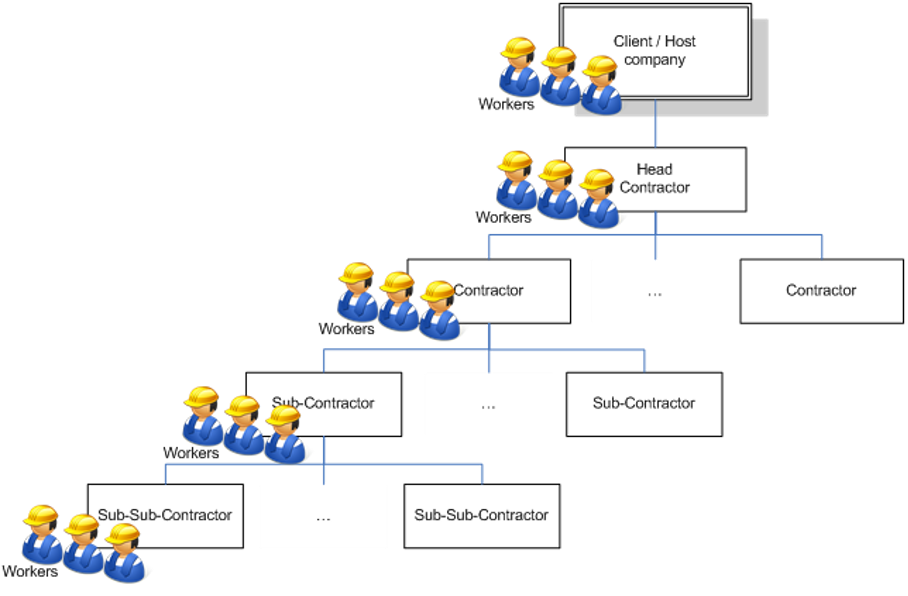
In this situation, a 'host company' or 'client', tend to focus on their core functions and engages another company, a contractor, to carry out specific tasks such as cleaning, maintenance, construction, waste disposal and catering. This type of relationship is also referred to as ‘outsourcing’. ISO 45001 defines a contractor as an “external organization providing services to the organization in accordance with agreed specifications, terms and conditions.” [4]. They can act as either production suppliers or service providers. Therefore, contractors are not workers of the client company, and they can engage other companies – subcontractors –to help fulfil contractual obligations. The relationships between the client company, its contractors and its subcontractors result in a contracting chain, as shown in Figure 1.
The chain forms a hierarchical socio-economic dependency network based on an intertwined series of commercial contracts[5]. However, outsourcing to other organisations does not lead to independence or equal relationships. Companies at lower levels in the value chain are often not in a position to act on equal terms with the client company. Sometimes they have to accept abnormally low contracts for the delivery of their products or services, which leaves them in a vulnerable position. Furthermore, in complex chains, liability between parties becomes unclear which may expose workers to fraudulent practices and deprive them of their rights allowing the main contractor to escape accountability[6]. It is particularly challenging to identify the ‘actual employer’ and protect workers’ rights at the lower levels of the subcontracting chain[7].
Figure 1: The contracting chain
Source[8]
The following definitions are used in this article and are visualised in the figure above[3]:
- client or host company – is the company (any employer in the public or private sector) that outsources the task. The work is usually done at the client site;
- contractor (and workers) – is the company that signs the contract with the client for providing goods or services and who is not an employee of the client;
- sub-contractor (and workers) – is a third company contracted by the contractor, for example, for specialised or minor ancillary works.
Why manage contractors?
Working with contractors and sub-contractors in complex chains appeared to be a critical issue for occupational safety and health (OSH) and thus is already well explored in EU-OSHA reports[2] [3] [9] [10] [11] [12] [13] [14] [15] [16].
Outsourcing and subcontracting can be associated with poor OSH management and an increased risk to the health and safety of workers[17]. Research studies have linked subcontracting with negative OHS outcomes, such as higher injury rates, exposure to diseases and mental health issues, across a variety of industries, including trucking, aviation, construction, mining, healthcare and manufacturing[18]. In the construction sector, for instance, financial and time pressures on subcontractors, difficulties in coordinating activities, limited supervision, and the inadequate information and training of subcontractors' workers have been shown to negatively impact health and safety management[19]. Data from the US on occupational injuries in the construction industry shows that mid- and downstream subcontractors, who receive most of their work from other contractors rather than the client company, tend to have higher injury rates than upstream contractors[20]. But also in other sectors high accident levels are reported among contract workers. A study in 2012 indicated that around 5% of total reports of chemical accidents in the eMARS major accident database were related to contractor work, and contractors accounted for 25% of fatalities[21]. Similarly, an analysis of 326 incidents involving hazardous substances at major hazard companies in the Netherlands from 2004 to 2018[22] found that, in more than half of the cases, the victims were contractors hired by the company, and one-third were the company's own staff, which may indicate that contractor workers are at greater risk.
Walter and James[3] concluded that contracting is related with a significant rise in ‘non-permanent’ labour, particularly in the form of self-employment and temporary work, and with a reduction of employment in large companies as well as a growth of employment in small and medium-sized enterprises (SMEs). SMEs often have less adequate and sophisticated systems of risk management. The commercial contracts with SMEs can limit the ability of those contractors to invest in preventive health and safety measures[1]. Also, in small companies job insecurity is high; workers are poorly paid, have low access to training and low control over working time, which in turn contributes to a lack of knowledge and awareness regarding safety issues and complaints[1] [3].
The problems regarding the safety and health performance of contractors may be increased by a lack of skilled and experienced labour and by the low frequency with which they are inspected. This leads to less secure, and more likely illegal, employment, where workers have limited access to trade unions and other forms of collective representation – organisations that can promote better health and safety and more adequate risk management systems[1] [3].
Since contractors perform their job in the client’s facilities, they can be exposed to unknown hazards, like biological agents, chemical products, asbestos or noise. Conversely, workers of the client company can also be exposed to hazardous situations derived from the work performed by contractors. These situations mainly originate in activities unfamiliar to the company workers or in activities that are performed unexpectedly[3].
Specific health and safety risks are illustrated by the following example on outsourcing of cleaning services[3] . Cleaning is a generic job carried out in all industry groups and all workplaces, outside and inside, including public areas. Cleaning is one task that is mainly contracted out. The cleaning industry is dominated by small businesses, most of which employ fewer than 10 workers. The working patterns of the cleaning sector tend to increase risks to worker health and safety, namely:
- the workforce in this sector tends to be employed on a part-time and temporary contract basis; it often does more than one job, is female-dominated, and has a high proportion of migrant workers and workers from ethnic minorities;
- cleaning is often done outside normal working hours, usually in the early morning, evening or night.
Besides this, cleaning workers have a poor perception of the safety issues that can affect their jobs. This problem sometimes is common also for managers of cleaning services and clients. Clients of cleaning companies appear to base their business decisions on price alone, without taking into account issues such as safety and health requirements, quality criteria, or even the security or trustworthiness of a contractor. Consequently, cleaning companies are under pressure to cut costs. This can result in an inadequate investment in training and other management activities essential for worker protection. A good procurement practice that benefits all (client companies, cleaning enterprises, and workers) should be applied with consideration paid to value for money instead of monetary aspects only.
What the law says about contractors
Provisions on OSH when working with contractors are included to some extent in the European OSH legislative framework and related national legislation. In the European Union, the Framework Directive (Council Directive 89/391/EEC of 12 June 1989)[23] requires employers to carry out a risk assessment and take the necessary measures to protect the safety and health of their workers. When assessing risks, the client should take into account the nature of all activities in his company (Article 6.3). This may also include the activities of contractors. However, the legal OSH framework regarding working with contractors is not clearly defined and regulated although some basic principles can be derived from the Framework Directive namely[1]:
- ‘Cooperation between client and contractor is needed in order to avoid putting their workers in hazardous situations. To accomplish such a goal both employers (client and contractor) shall inform one another and their respective workers and/ or workers’ representatives of the hazardous situations they are exposed to. They shall also coordinate their actions in matters of protection and prevention of occupational risks’ (Article 6.4).
- ‘The client shall also provide the contractor with adequate information and appropriate instructions regarding safety and health risks and safety measures during their activities in his undertaking’ (Article 10.2 and Article 12.2).
The EU Framework Directive is complemented by individual Directives on the implementation of minimum safety and health requirements, addressing different types of risks or work activities. For instance, Council Directive 92/57/EEC of 24 June 1992[24] on the minimum safety and health requirements at temporary or mobile construction sites ( ‘Construction Sites Directive’), establishes that the client or the project supervisor shall appoint one or more co-ordinators for safety and health matters for any construction site on which more than one contractor is present. Temporary or mobile construction sites means any construction site at which building or civil engineering works are carried out, which include repair and maintenance activities. To support the implementation of the Construction Sites Directive the European Commission published a non-binding guide[25] providing explanation, good practices and information for all stakeholders involved in construction projects, including clients, project supervisors, co-ordinators for safety and health matters at the preparation and execution stages, (sub-)contractors, etc. Chapter 3 of this guide mentions the important role of public authorities in giving incentives to companies with regard to socially responsible and OSH management, by means of their procurement approach. As public purchasers command a large share of the market (e.g. in construction), their impact on their (sub-) contracting chain is significant. The legal basis for public procurement at EU level is provided by the Procurement Directives, namely Directives 2014/25/EU[26] and 2014/24/EU[27].
The importance of the 4 Cs: Control, communication, co-ordination and competence
The involvement of clients and (sub-)contractors in providing adequate OSH to their workers requires careful attention at all phases of the interaction between the entities. It begins at the pre-contract stage with a thorough assessment of (sub-)contractor competence and selection of safe contractors. It continues throughout the job execution via close co-operation of all parties and appropriate levels of supervision. At contract termination, it ends by reviewing and recording the OSH performance of contractors and sub-contractors. Furthermore, the complex chain of organisations involved in outsourcing leads to complex forms of communication[3].
The literature addresses several approaches that can be used to achieve safer and healthier workplaces in outsourcing, thus contributing to reducing work accidents and work-related diseases. These approaches focus on issues such as contractual clarification of responsibilities and planning; communication, co-ordination, co-operation and training; joint control procedures; and contractor evaluation.
There is some evidence that working together for managing safety and health in the workplace improves OSH performance. A positive joint approach to OSH based on openness, integration and sharing experiences are the cornerstones of successful contractor management. Therefore, it is recommended to set up collaborative agreements between client and contractors fostering a joint OSH approach. However, it is clear, that time and effort are required, and that all parties must be committed to developing a collaborative culture throughout projects and services. Wherever possible, long-term partnerships are therefore preferred. It is essential that the parties with their different background and culture work together as one team with agreed common goals. The process of changing behaviours and values to those required in a partnering culture is a deep-seated one. There will be many challenges along the way, which will test individual resolve and the strength of the relationship. At these times, in particular, strong leadership focused on the common objectives is critical to success[28].
An example from a large construction project in Denmark highlights the crucial role of safety culture in improving OSH across an entire contracting chain[29]. The project’s OSH strategy was built on two key pillars: a) integrating OSH considerations into all project decisions, meetings, and documentation, and b) ensuring that both the client’s and the main contractor’s top and line management demonstrated visible commitment to OSH.
From the start, all contractors and subcontractors involved in the project were introduced to the health and safety objectives, rules and expectations, which clearly indicated the importance that the client company placed on OSH. This commitment was reinforced through systematic practices. For example, health and safety was a mandatory item on the agenda of all project meetings and a standing topic during daily 'toolbox' meetings, where work crews discussed the day's tasks and potential risks.
To further demonstrate leadership engagement, senior management organised weekly joint activities with main contractor representatives. Project directors also conducted up to three site visits per week, each focusing primarily on OSH performance and practices[29].
Recommendations related to the 4 Cs (Control, communication, co-operation and competence) can help to create a positive safety culture and improve contractor management[3]:
- Outsourcing should be based on a strong relationship between client and (sub-) contractors supported by information and communication.
- Companies should select ‘safe contractors’ based on a sound procurement strategy that considers ‘best value for money’ rather than ‘lowest price’.
- Client company, (sub-)contractors and workers should combine efforts in order to find the best solutions to ensure an adequate performance and safety of outsourced tasks.
- The outsourcing contract should contain information on the potential hazards and the measures that have been taken to eliminate or limit them.
- It is advisable that a third-party certification exists in order to evaluate, certify and ensure the performance and competencies of individuals (workers) or companies (contractors, and those working for them: sub-contractors), with regard to OSH (and environmental issues).
- Training (sub-)contractors in OSH issues for aligning procedures, harmonising safety culture and improving OSH performance is necessary.
- Companies should implement control procedures.
How to manage contractors: What to consider when selecting a suitable contractor
When managing contractors, it is important to define a sound profile for them including their qualifications, skills, competencies and experience as well as a job description that takes health and safety into account. Moreover, vetting procedures and a list of approved contractors can help in the selection of contractors. When contractors are working for longer times for the same company this is beneficial for safety. Collaboration with professional training institutes and vocational schools can be helpful.
Examples of what questions you can ask a contractor during the selection phase are:
- What arrangements will you have for managing the work?
- Who will be responsible?
- How will the work be supervised?
- What checks do you make on equipment and materials, etc.?
- Will subcontractors be used? If so, how will they check their competency?
- Are language and/or (interorganisational) culture barriers identified and managed?
- What is their recent health and safety performance?
- How many accidents and cases of ill health have they had over the past five years?
- Can they provide a risk assessment for a similar job? What qualifications, skills and experience do they have in these types of work?
Before the contractor commences work, it is important to understand how the associated risks are assessed, by whom they are assessed, and how control actions with the contractor are agreed.
Before the contractor commences work, it is important to clarify how risks are assessed and which control measures will be implemented. Formal contracts help to clarify the roles and responsibilities of contractors, define the desired outcomes, and set out procedures for non-compliance[16].
During the work, the following aspects are important:
- introduction procedures for new contractor’s onsite – what should be included;
- what information, instruction and training should be provided to contractors?
- managing and supervising the work – by whom and how?
Afterwards an evaluation of the contractor’s work should be undertaken, based on the earlier mentioned profile and risk indicators. It is beneficial for the evaluation of the contractor and its work if the start-up is carried out thoroughly. In the contracting and start-up phase of a project, agreements are made on responsibilities, project outcomes and collaboration partners. These agreements can be evaluated at the end of the project and positive and negative experiences can be shared and learned form.


