Introduction
The construction industry forms an important part of the economies of all countries, employing a substantial workforce. It is also one of the most hazardous industries in the EU as well as in many other countries around the world. Major safety hazards for construction workers include working at heights, in excavations and tunnels, on highways, in confined spaces, exposure to electricity, construction machinery, etc.
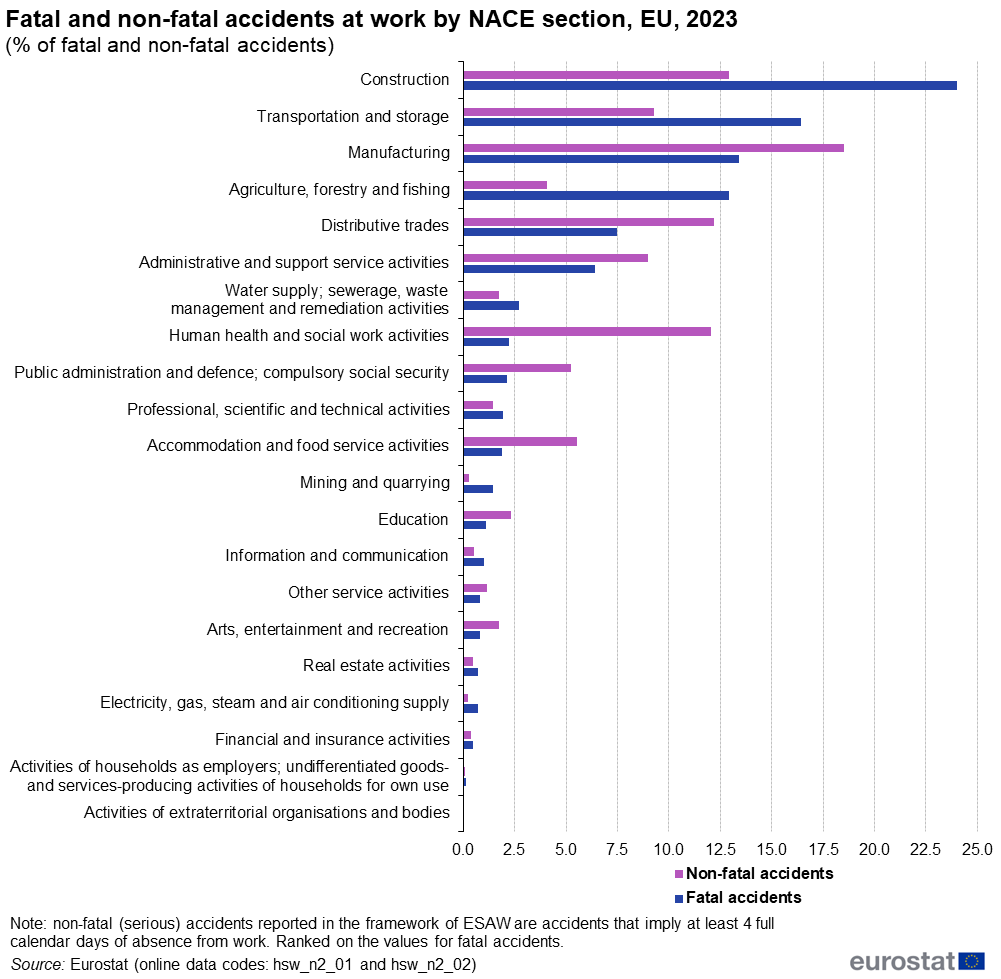
Despite major efforts in many countries to improve safety performance, the construction sector continues to lag behind most other industries[1] [2]. In 2023, almost a quarter (23%) of all fatal accidents at work in the EU occurred in the construction sector[3].
Facts & figures
The construction sector in Europe
Construction is one of the largest economic sectors in all countries around the world. According to Eurostat[4], an estimated 13.4 million people were employed in construction in the EU in 2021, representing 8.6% of total employment. There were an estimated 3.7 million construction enterprises in the EU, generating €615 billion added value.
Most construction enterprises serve a local market. Consequently, the construction sector is characterised by a high number of small enterprises, and relatively few large ones. Over 90% of all construction companies have less than 10 employees and only 1% of all enterprises in the construction sector employ 50 or more people[5].
The construction industry includes construction of buildings (code 41, NACE Rev. 2.1)[6], civil engineering (code 42) and specialised construction activities (code 43) (i.e. demolition, site preparation, installation, completion and finishing). The largest of these three sub-sectors in 2021 was specialised construction, accounting for almost 60% of construction value added and an even higher share of construction employment (63.5%)[4].
The Council Directive 1992/57/EEC of 24 June 1992 on the implementation of minimum safety and health requirements at temporary or mobile construction sites (Construction Sites Directive 92/57/EEC)[7] categorises 'construction work' into the following activities: excavation, earthworks, construction, assembly and disassembly of prefabricated elements, conversion or fitting-out, alterations, renovation, repairs, dismantling and demolition, upkeep, maintenance - painting and cleaning work, drainage. Construction work applies thus to work during the ‘whole-life cycle’ of a facility from its inception to its eventual demolition and any on-site recycling of its materials[8].
Occupational safety
Apart from its economic relevance and importance, the sector is also responsible for about 20-30% of all known serious occupational injuries and, most probably, at least an equivalent share of occupational illnesses[1] [9].
Poor construction safety and associated fatal and non-fatal occupational injuries have been reported in many studies from around the world[10]. According to Eurostat, almost a quarter (24%) of all fatal accidents at work in the EU occurred in the construction sector[3]. while transportation and storage (16.4%) had the next highest share (Figure 1). The construction sector recorded the highest incident rate of non-fatal workplace accidents in the EU, with 2,961 accidents per 100,000 employed individuals. This indicates that construction workers face a significantly greater risk of workplace accidents compared to those in other industries[11].
Figure 1: Fatal and non-fatal accidents at work by NACE section, EU, 2023 (% of fatal and non-fatal accidents)
Source[3]
The majority of construction fatalities result from falls from heights and being struck by moving vehicles, whilst the majority of non-fatal injuries result from slips, trips and falls, and from being struck by a moving or falling object[10] [12][13]. A Danish research study revealed that absence length of lost-time injuries in the construction sector was significantly dependent on the type of injury. Sprains and strains were most prevalent and accounted for approximately one third of injuries and absence. Fractures accounted for one sixth of injuries and the greatest proportion of long-term absence[14].
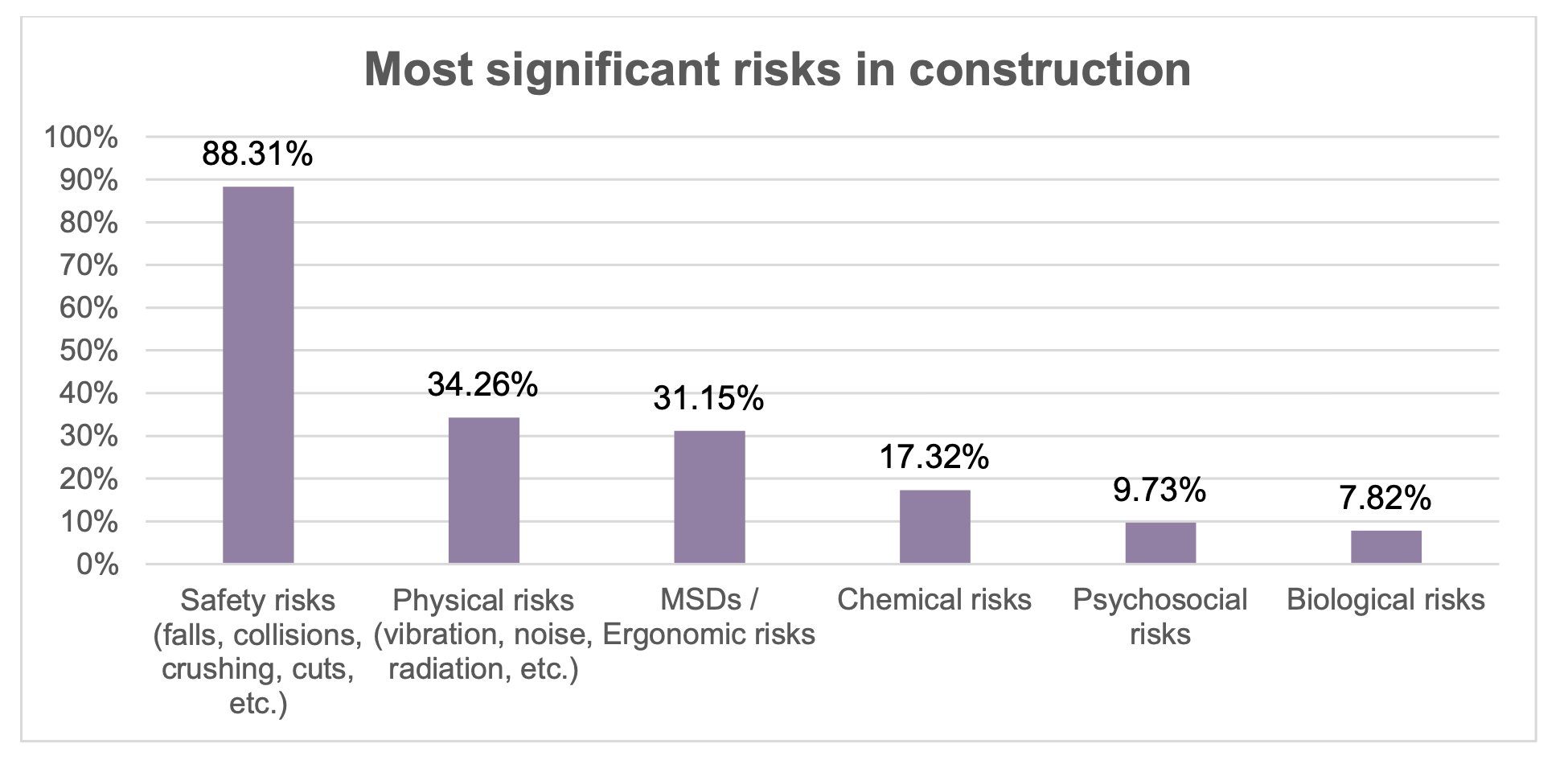
The results of a survey of occupational safety and health (OSH) inspectors across the EU[15] show that the vast majority of respondents (62%) consider the construction sector to be the most dangerous. The survey was developed jointly by EU-OSHA and the Senior Labour Inspectors Committee (SLIC) to capture the perspective of labour inspectors on high-risk occupations. More than 2000 labour inspectors from across the EU responded to the survey. They identified safety risks (falls, collisions, crushing, cuts, etc.) as the predominant risk category, followed by physical risks (vibration, noise, radiation) and MSDs/ergonomic risks (figure 2)15.
Figure 2: Most significant risks in construction (survey labour inspectors – 2021)
Source[15]
Safety hazards, risks and accidents
Major hazards and risks
The main hazards and risks of accidents in the construction sector can be categorised and described in the following way8:
- risks of slips, trips and falls
- risks related to instability
- risks related to traffic
- risks related to construction machinery
- fire and explosion risks
- risks related to the environment
- risks related to (sub)contracting
- risks related to green jobs.
Slips, trips and falls
In the construction sector, slipping, stumbling or falling is the leading cause of both fatal (30%) and non-fatal accidents (20%) while in other sectors it is losing control of machines, tools or transport and handling equipment (figure 3).
Slips, trips and falls may have serious consequences, causing severe injuries such as broken bones or concussion. Key aspects of construction slips, trips and falls include uneven surfaces, obstacles, trailing cables, wet or slippery surfaces, and changes in level. Contractors and others in control of construction sites must therefore manage work so that people can move safely around the site.
Work at height
Falls from height are the main causes of fatal accidents in the EU construction industry[10] [13] . The risks related to work at height may be subdivided in two groups: (1) those that may arise from the fall of workers, and (2) those that may arise from the fall of objects onto those working below.
These risks may arise at most construction sites. The consequences are generally more severe the greater the falling height. Falls generally occur from unguarded edges or openings at height, roof work, through fragile materials, into excavations, from ladders, from temporary platforms like tower scaffolds, from places of work on an existing facility and on stairways.
There is a need to assess the risk from work at height and to organise and plan the work so it is carried out safely. Managing work at height follows a hierarchy of controls - avoid, prevent, arrest - which begins with the question: 'Can the work be done safely from the ground?'. Fall restraints and safety netting should only be considered as a last resort if other safety equipment cannot be used. Comprehensive practical advice can be found in the non-binding guideline ‘How to choose the most appropriate work equipment for performing temporary work at a height’[16].
Erecting and dismantling of scaffolding or any other similar equipment
Risks related to scaffolding may be subdivided in two groups: (1) those involved during the assembly, alteration and dismantling of the scaffolding; and (2) those related to the use of the scaffolding (e.g. risk of slipping). These risks can be present whenever scaffolds are used. Comparable risks arise when systems similar to scaffolding are used in falsework (i.e. temporary structures used in construction to support spanning or arched structures in order to hold the component in place until its construction is sufficiently advanced to support itself).
The incidents that occur are mainly caused by:
- dangerous methods of erection or dismantling - where a safe system is not being followed;
- defects in the erected scaffold - where the tower structure is incorrectly assembled or where a platform guardrail is missing;
- misuse of the scaffold – where a ladder is used on a tower causing it to overturn or when a person falls while the tower is being moved.
Directive 2009/104/EC concerning the minimum safety and health requirements for the use of work equipment by workers at work[17] applies to scaffolds. Competent persons should draw up an assembly, use and dismantling plan. Standardised forms and documents can assist when checking scaffolds on a large project. Some small system scaffolds (e.g. small mobile tower scaffolds) can be safely erected following limited training and competence assessment provided strict controls are maintained.
Erection and dismantling: should use[18]
- Advance guard rail system - where temporary guard rail units are locked in place from the level below and moved up to the platform level. They are in place before the operator accesses the platform to fit the permanent guardrails.
- ‘Through-the-trap’ - involves the operator taking up a working position in the trap door of the platform, from where they can add or remove the components that act as the guardrails on the level above the platform. It is designed to ensure that the operator does not stand on an unguarded platform.
Stability: to maintain tower stability there is a need to make sure that[18]:
- the tower is resting on firm, level ground with the locked castors or base plates properly supported. Never use bricks or building blocks to take the weight of any part of the tower;
- stabilisers or outriggers are installed when required by the instruction manual; and
- a tower is never erected to a height above that recommended by the manufacturer.
Using and moving[18]:
- Never use a tower:
- in strong winds;
- as a support for ladders, trestles or other access equipment;
- with broken or missing parts; or
- with incompatible components.
- When moving a tower you should always:
- reduce the height to a maximum of 4m;
- check that there are no power lines or other obstructions overhead;
- check that the ground is firm, level and free from potholes; and
- push or pull using manual effort from the base only.
- Never move a tower while people or materials are on the tower, or in windy conditions.
Falls on the same level
Risks related to falls on the same level generally come about by tripping and slipping. They are likely to be more prevalent on untidy sites[19].
Risks related to instability
Risk of injury may be created by falling objects from an upper level or from the collapse of structures, earthworks and equipment (e.g. cranes). Instability can adversely affect existing facilities at or nearby the project, new structures under construction and temporary structures erected as a part of the construction work. Loss of structural integrity can be due to a number of causes. These include failures in design especially of temporary works, failures in correctly executing the works as designed and failures in properly monitoring the work being undertaken to take account of the unforeseen. Complex excavations such as tunnels, shafts and deep excavations in urban areas require particular care[20]:
- loose materials may fall from spoil heaps into the excavation;
- excavations may undermine scaffold footings, buried services or the foundations of nearby buildings or walls;
- the extra loadings of plant and vehicles can make the sides of excavations more likely to collapse.
Risks related to traffic
Risks related to working on existing roads with live traffic depend on the type of work to be performed. Collisions can occur between vehicles working on site, and between vehicles passing close to the site, or by passing vehicles with site machinery, equipment (e.g. scaffolds) and workers (perhaps where the site is not adequately signed and physically protected). Work in existing tunnels can present particular risks from and to moving traffic.
Things to consider when minimising vehicle movement[21]:
- provide car and van parking for the workforce and visitors away from the work area;
- control entry to the work area; and
- plan storage areas so that delivery vehicles do not have to cross the site.
Risks to pedestrians from on-site traffic can be reduced by providing segregated pedestrian and vehicular routes that are properly demarcated and by providing added protection for pedestrians at places of particular risk. Crossing points require particular attention.
Things to consider when trying to keep pedestrians and vehicles apart[21]:
- Entrances and exits - provide separate entry and exit gateways for pedestrians and vehicles;
- Walkways - provide firm, level, well-drained pedestrian walkways that take a direct route where possible;
- Crossings - where walkways cross roadways, provide a clearly signed and lit crossing point where drivers and pedestrians can see each other clearly;
- Visibility - make sure drivers driving out onto public roads can see both ways along the footway before they move on to it;
- Obstructions – do not block walkways so that pedestrians have to step onto the vehicle route; and
- Barriers - think about installing a barrier between the roadway and walkway.
If vehicles reverse in areas where pedestrians cannot be excluded the risk is elevated and visibility becomes a vital consideration. Things to consider in relation to visibility[21]:
- Aids for drivers - mirrors, CCTV cameras or reversing alarms that can help drivers can see movement all-round the vehicle;
- Signallers - who can be appointed to control manoeuvres and who are trained in the task;
- Lighting - so that drivers and pedestrians on shared routes can see each other easily. Lighting may be needed after sunset or in bad weather;
- Clothing - pedestrians on site should wear high-visibility clothing.
Make sure that all drivers and pedestrians know and understand the routes and traffic rules on site. Use standard road signs where appropriate[21]. Directive 92/58/EEC provides additional requirements for the provision of safety and/or health signs[22].
Risks related to construction machinery
Risks from construction machinery depend upon the type of equipment (e.g. earthmoving equipment, lifting equipment, etc.) and the work activities.
- Risks related to earthmoving equipment (backhoes, loader shovel excavators, etc., including their accessories) may include: roll-over of the equipment, objects falling onto the equipment, and from malfunctioning safety and other warning devices, etc.
- The risks related to lifting equipment (e.g. tower cranes, mobile cranes, etc., including accessories such as slings) may include: workers falling from height during the installation, operation and dismantling of the equipment, collapse of the equipment during use due to overloading or during erection and dismantling, and failures due to poor slinging techniques, etc. Reducing the likelihood of accidents can be achieved through measures such as ensuring operator competence following machine-specific training, proper work planning and supervision, and effective arrangements for inspection, maintenance, and repairs..
Directive 2009/104/EC concerning the minimum safety and health requirements for the use of work equipment by workers at work addresses these kinds of issues[17].
Fire and explosion risks
Fire risks on a construction site have many sources such as:
- the use of flammable liquids
- welding or abrasive cutting techniques used in places not specially prepared for such works
- liquid gases used with an open flame;
- flammable and combustible materials (e.g. petroleum, timber and packaging).
Explosive atmospheres can be present at construction sites because of the processes being undertaken by those carrying out the construction works and by others carrying out other industrial processes. Explosion risks can typically occur from:
- the use of solvents and ignition by sparks;
- static electricity (e.g. it might ignite blasting agents);
- explosive atmospheres in sewers;
- damage to pipes containing explosive gases; and
- unexploded ordinance in the ground.
The Explosive Atmospheres Directive 1999/92/EC requires particular precautions to be taken[23]. Substitution of explosive materials as far as possible, good ground exploration and trained workers reduce the likelihood of explosions.
Risks related to the environment
Construction workers are often exposed to environmental factors such as dirt, dust, noise and vibration, all of which can increase the risk of accidents. In addition, working outdoors in adverse weather conditions, whether extreme cold or heat, contributes to a challenging and often unsafe working environment. Research has shown that both cold and heat significantly increase the likelihood of occupational accidents[24], a risk that is expected to worsen as the effects of climate change continue.
Risks related to (sub)contracting
Construction work is often subcontracted. In common usage, a contractor is a person (natural or legal) who undertakes or manages construction works; a subcontractor is a person who undertakes or manages construction work assigned to them by a contractor[8].
The high use of subcontracting is closely linked to the temporal and spatial realities of construction work. The workplace often changes location or form, and although construction projects can extend over long periods of time, they are by their very nature temporary, which means that workers are needed only temporarily[25]. Specialised companies and their workers are hired to perform the work better, faster and usually more cheaply. So when employers hire contractors, these contractors in turn could hire subcontractors and a chain of companies emerges. The executed work often takes place mostly where the lead contractor is working. This has implications for the safety and health of the workers involved[26] [27]. The risks are exacerbated by the economic challenges of a project-based sector where cost is one of the main factors in tenders - both public and private - that determine who wins contracts. These economic pressures can be a catalyst for inadequate risk control. In addition, the high degree of complexity in the organisation of large construction projects plays a role in exacerbating OSH risks in the sector. Work must be carried out simultaneously by several contractors, each with its own management structure, and often from different countries, which can lead to language barriers[25]. As supply chains become longer and longer, responsibility for occupational safety and health is often delegated along with the work to small subcontractors who are under considerable economic pressure. These small contractors, at the bottom of the construction value chain, often employ migrant workers who are more vulnerable and more likely to be injured[28].
More information on risks related to subcontracting in the construction sector is available in the EU-OSHA report Improving OSH through supply chains: market-based initiatives in the agri-food and construction industries[28]
Risks related to green jobs
Green jobs can be understood as contributing, in some way, to the preservation or restoration of the environment. They can include jobs that help to protect ecosystems and biodiversity, or reduce consumption of energy and raw materials, or reduce waste and pollution. The new technologies or working processes associated with green jobs can lead to new hazards, which call for new combinations of skills to deal with them: the 'old' OSH knowledge cannot simply be transferred to them. Installing a solar water heater, for example, involves combining the skills of a roofer, a plumber and an electrician[29].
Green construction jobs relate amongst others to the construction of 'green buildings' (i.e. structure that is environmentally responsible and resource-efficient throughout its life-cycle, from siting to design, construction, operation, maintenance, renovation, and demolition) and building retrofitting (insulation, heat retaining windows, ventilation with heat recovery, energy-efficient lighting), but also to the construction of, for example, wind turbines. In off shore wind farms the risks are multiplied many-fold, making them potentially highly dangerous worksites. With so many large turbines in ever-deeper water, ever further from a safe haven, access issues are the dominant OSH consideration. Working sites are more widely dispersed, with lower profit margins to pay for safety than in the oil and gas industries. Construction is hazardous and with the large numbers of turbines come skill shortages, as wind competes with other technologies for qualified staff[1].
Causal influences in construction accidents
Construction accidents related to the abovementioned hazards and risks, will arise from a failure of different factors. One of the main problems with construction safety is, for example, that hazards in a construction site may change from day to day. In addition, many workers will go from site to site where they will be exposed to different hazards or where hazards are being managed differently.
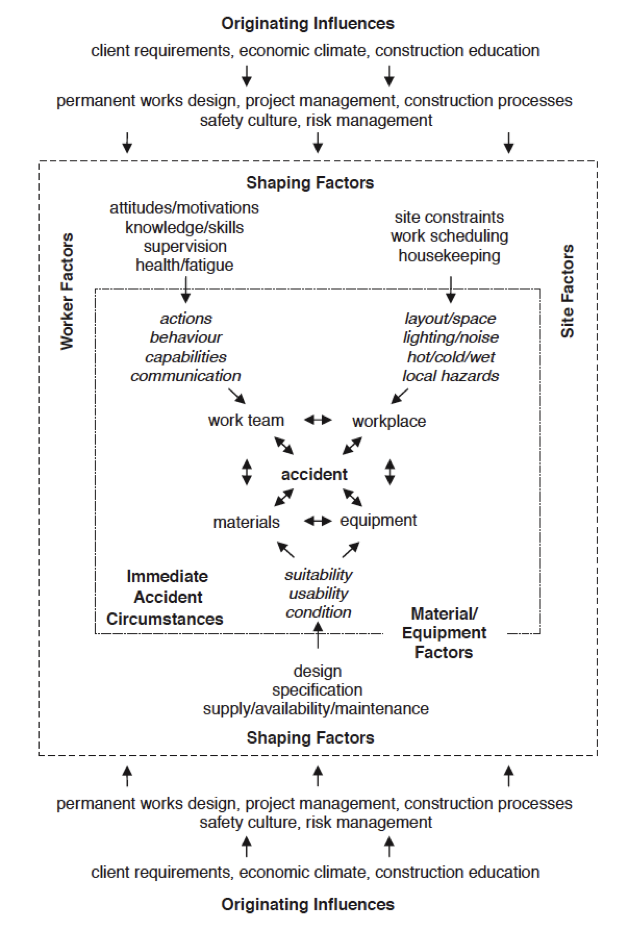
Based on several accident studies, Haslam et al.[13] have proposed a model on the hierarchy of causal influences in construction accidents (Figure 4). According to the model, the following four interlinked factors give rise to the 'immediate accident circumstances':
- worker and work team ('shaping factors': worker actions and behaviour, capabilities, communication, health, and available supervision);
- workplace ('shaping factors': site conditions and layout, work environment, work scheduling, and housekeeping);
- materials ('shaping factors': material suitability, usability, and condition);
- equipment ('shaping factors': equipment suitability, usability, and condition).
These immediate causes of construction accidents are influenced by some organisational, managerial and design factors (i.e. 'root causes'): construction design and processes, project management, risk management, client and economic influences, and safety culture, training and awareness[30].
Figure 4: Hierarchy of causal influences in construction accidents
Source[13]
Legal requirements
General
- The general OSH Framework Directive[31] is applicable, as well as several of the individual Directives on the implementation of minimum safety and health requirements, addressing different types of risk exposures, including:
- Council Directive 1992/57/EEC of 24 June 1992 on the implementation of minimum safety and health requirements at temporary or mobile construction sites[7]
- Council Directive 1992/58/EEC of 24 June 1992 on the minimum requirements for the provision of safety and/or health signs at work[22]
- Council Directive 1999/92/EC of 16 December 1999 on minimum requirements for improving the safety and health protection of workers potentially at risk from explosive atmospheres[23]
- Council Directive 2009/104/EC of 16 September 2009 concerning the minimum safety and health requirements for the use of work equipment by workers at work[17].
Construction Sites Directive
The Council Directive 92/57/EEC of 24 June 1992[7] - or shortly, the 'Construction Sites Directive' - lays down minimum safety and health requirements for 'temporary or mobile construction sites', i.e. any construction site at which building or civil engineering works are carried out and intends to prevent risks by establishing a chain of responsibility linking all the parties involved.
The Directive requests all responsible persons to establish a chain of responsibility linking all the parties involved, i.e. building owners, clients, contractors and sub-contractors. In specific cases the competent authorities have to be notified before work can start. The client or project supervisor nominates person(s) responsible for the coordination of health and safety at sites where several firms are present. A health and safety plan has to be drawn up.
For all projects the directive requires to:
- check competence and resources of those they appoint (e.g. designers or contractors);
- allow sufficient time and resources for the work to be done safely;
- provide key information to designers and contractors - it is for the clients to arrange for any gaps in information to be filled (e.g. commissioning an asbestos survey);
- ensure that all those involved in the work co-operate and co-ordinate their activities;
- establish a competent project team early on which fosters a culture of co-operation and integration;
- ensure suitable management arrangements are in place.
Some construction works are notifiable under Directive 92/57/EEC. These are construction projects with a construction work lasting longer than 30 days or construction work involving 500 person days. The client will notify the competent authorities before the works starts. The notice must be displayed on the construction site. For notifiable projects the directive requires to:
- appoint competent coordinator for health and safety;
- provide coordinator with key information;
- ensure the construction phase does not start unless there is health and safety plan in place.
Based on the need to reinforce the implementation of the Construction Sites Directive 92/57/EEC the European Commission published a non-binding good practice guide providing explanation, good practice suggestions and information for all stakeholders involved in construction projects[8].
Prevention
Types of prevention measures
According to the model presented above (Figure 3), interventions for preventing or reducing construction injuries should focus on five main areas: (1) the workers and work teams, (2) the workplace, (3) the materials, (4) the equipment and (5) the organisation. These factors are often categorised into the following domains:
- technical measures: engineering controls, personal protective equipment (safety helmets, safety harnesses, eye and respiratory protection, safety footwear), safety signs, maintenance, etc.
- organisational measures: safety management systems, procedures, rules, etc.
- personal/behavioural measures: awareness raising, safety training, hazard recognition, behavioural-based safety (BBS) programmes, toolbox meetings, etc.
The social environment of construction workers plays a crucial role in influencing safe behaviour, both positively and negatively. If a construction worker works in a crew or team where safety is an integral part of the job he will behave accordingly [32]. Competent foremen (supervisors, frontline management) are in this regard the key to improving construction site safety[13] [33]. As construction workers have an informal and oral culture of risk, in which safety knowledge is understood without being openly expressed, it is of great importance that foremen lead by example, talk continually about safety, and listen to workers' concerns and build ownership and responsibilities[34].
A literature review[10] revealed that the vast majority of technical, human factors and organisational interventions have not been adequately evaluated making it difficult to demonstrate the effectiveness of prevention measures; The authors concluded that introducing regulations alone may not be effective for preventing injuries in construction workers[10].
According to Swuste et al.[32] the ‘frappez toujours’ approach (French for 'be persistent) may yield noticeable results: it does not really matter which initiative or intervention is adopted and its effectiveness is not an important point, as long as the topic of safety intervention buzzes around long enough, including gaining media attention results.
In general, it can be concluded that when various prevention measures are used in combination and these measures succeed in influencing social norms and public opinion, they are more effective than safety intervention targeting individuals only[35].
Prevention throughout the different project phases
Construction engineering is a phased process. A large construction project consists generally of four project phases or stages: conceive, design, implement (construction) and operate35. Safety needs in this regard to be owned and integrated across the project team - from designers and engineers through the (sub)contractors and their workers.
The importance of attention for OSH in all stages or phases of a construction project is addressed in the Construction Sites Directive 92/57/EEC[7]. More specifically, the Directive mentions two principal stages: – the preparation phase, which includes inception, design, and preparation prior to commencing on site; – the execution or construction phase, which essentially involves construction work on site until the project is completed.
Safety in the preparation stage
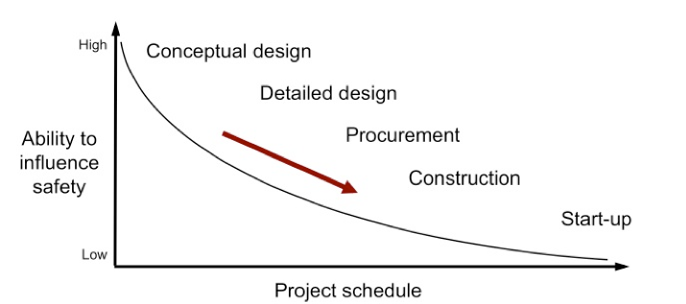
The role of the design professional has traditionally been to design a building or structure. The safety of construction workers is partly left up to the contractors. However, design professionals can influence construction safety by making better choices in the design and planning stages of a project. Research shows that decisions concerning the design of projects have a major impact on site safety. Making better choices in the design stages can eliminate a considerable percentage of construction injuries. Figure 5 represents in this regard the ability to influence construction safety versus time (the project schedule).
Figure 5: Ability to influence construction safety versus time
Source: based on[35] [32]
Designing for Construction Safety (DfCS) is in this regard an important approach. DfCS is the process in which (civil) engineers and architects explicitly consider the safety of construction workers during the design process. Four specific trajectories can be identified that DfCS is likely to follow:
- increased prefabrication
- increased use of less hazardous materials and systems
- increased application of construction engineering
- increased spatial investigation and consideration.
This approach implies that design engineers will need to become better information gatherers and communicators on project-related information (e.g. communicating with prefabricators on the applicability and availability of prefabricated components)[36].
Safety in the execution phase
Safety during the construction stage is primarily the responsibility of the client and contractors. According to the Construction Sites Directive 92/57/EEC[7], the client has the following obligations:
- appointing project supervisors to assist them if they so wish;
- sending a prior notice to the competent authority;
- appointing one or more coordinators for safety and health matters when required;
- ensuring that safety and health plans are drawn up when required; and
- taking account of the general principles of prevention during design and preparation for a project, including the time that the work will require.
Conclusions
Construction is worldwide one of the most hazardous industries. Despite major efforts to improve safety performance in many countries, the construction sector continues to lag behind most other industries. The construction sector should be encouraged to benchmark its safety practices and performance against other industries, and to take greater advantage of opportunities to learn from failures by implementing accident investigation procedures to identify contributing factors earlier in the causal chain13. As the world has become smaller through technology and through cooperative, border-crossing arrangements, construction worker safety has become a concern that is shared worldwide. Because construction safety problems are very similar from country to country, they can be addressed and solved on a global scale. Solutions to safety problems in one country can, in this regard, readily be adopted in other countries to generate further improvements[1].


