


In the following article challenges facing the public administration and their effects are described, with a concentrated focus on psychosocial issues. The effects of task requirements, work equipment, physical work environment, social work environment and social factors will be highlighted and, in turn, discussed.
There are several definitions of “public administration" based on the different structures in each European state. In general, public administration includes legislative activities, taxation, national defence, public order and safety, immigration services, foreign affairs and international assistance, and the administration of government programmes are activities that are purely governmental in nature[1]. In 2023, an estimated 7% of the working population in the EU was employed in public administration (NACE code O: Public Administration and Defense; Compulsory Social Security)[2].
According to the European Working Conditions Telephone Survey (EWCTS, 2021)[3], 38% of the workers in the public administration, education and health sector think their health or safety is at risk due to their work. 38% is also the average across all sectors. Higher values can be found in Agriculture and industry (46%), Construction and transport (43%) and lower values in Commerce and hospitality (30%) and Financial and other services (28%)[4]. In 2020, almost 10% of people working in administrative and support services including public administration in the EU reported one or more work-related health problem in the past 12 months (Labour Force Survey, 2020)[5]. The reported average of work-related health problems across all occupational sectors was 10.3 %, with the highest value found in Agriculture, hunting and forestry (15.8 %) and the lowest values in Professional, scientific and technical activities (7.3 %)[5]. Data from the OSH Pulse survey[6] show that 27% of the respondents working in the Public Administration sector reported work-related poor mental health. This is in line with the average for all sectors (26.8%) and is lower than, for example, education (31%) or health (29.8%) and higher than manufacturing (23.1%), agriculture (22.1%) or construction (21.9%)[6].
Research has shown that work-related psychosocial issues are associated with different health aspects, such as exhaustion and presenteeism[7], depression and anxiety disorders[8], burnout[9] and other stress-related mental disorders[10] as well as musculoskeletal disorders[11] and cardiovascular diseases[12] [13].
Psychosocial risk factors are also associated with a higher prevalence of sickness absence. Research by Edwards and Webster[14] showed that stress-related employee absence is higher in the public compared to the private sector in the United Kingdom. Similarly, a study by Munch et al.[15] involving 13,437 employees from 698 public service workplace units in Denmark revealed that satisfaction with psychosocial work conditions has a significant and independent impact on reduced sickness absence. Another Danish study focusing on senior public service employees found that a poor psychosocial work environment and organisational change contribute to non-disability early retirement[16]. These findings highlight the substantial economic burden of psychosocial risks and work-related stress, which affects multiple levels: employees (e.g. lost income), organisations (e.g. reduced productivity), and society (e.g. increased health and social security costs). An Italian case study in a public administration department (534 employees) estimated the cost of work-related stress at €360,000. The estimation was based on a cost-estimation model using data on for work-psychosocial risk exposure and absence from work[17].
In the following sections, central issues in relation to work-related psychosocial issues in public administration will be discussed in more detail.
Task requirements include all factors related to job content and control, workload and work schedule (e.g. shift work), irregular work schedules, role ambiguity and lack of stimulating work. Looking at the overall job quality, data from the EWCTS 2021 show that 1 out of 2 jobs in the public administration is moderately to highly strained (figure 1)[3]. Strained jobs are characterised by an imbalance between job demands and job resources. Compared to the other sectors, the public administration sector is among the sectors with the lowest percentages of strained jobs.
Figure 1 Job quality index, by sector, EU27 (%) 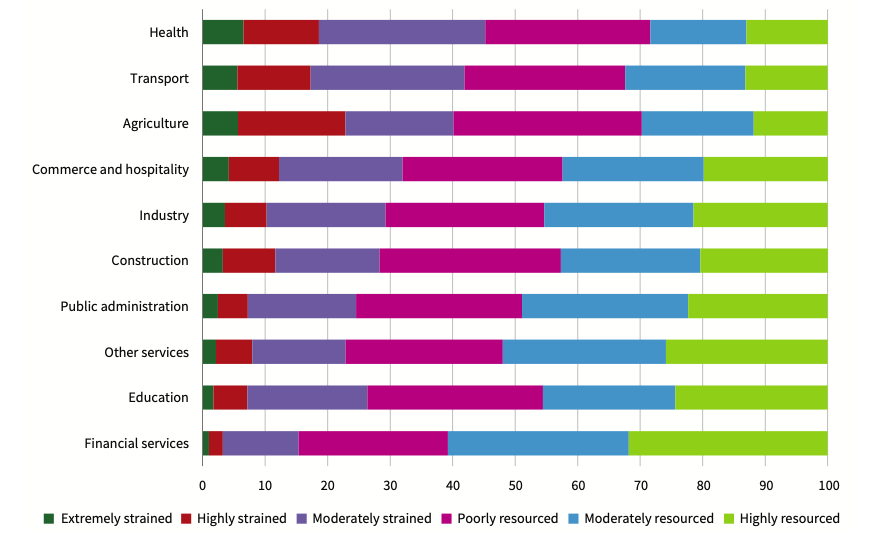
Source[3]
In addition, results from The European Survey of Enterprise on New and Emerging Risks (ESENER-3 2019)[18] show that psychosocial risk factors are common in the Public Administration sector. Moreover, between 2014 and 2019, the percentage of establishments reporting psychosocial risk factors, has increased (see table 1). The scores in the Public Administration sector are higher compared to the average for all sectors except for the risk factor “Long or irregular working hours”[18]. Similar findings emerge from the OSH Pulse survey 2022[6]. Especially when it comes to working under pressure. Almost one in two public sector workers (48%) report severe time pressure or work overload. Only the health sector reports a higher number (51%)[6].
Table 1 Psychosocial risk factors present in the establishment (% Yes) - ESENER-3, Comparison 2014 - 2019
| Pressure due to time constraints | Poor communication or cooperation within the organisation | Having to deal with difficult customers, patients, pupils etc. | Long or irregular working hours | |||||
|---|---|---|---|---|---|---|---|---|
| 2014 | 2019 | 2014 | 2019 | 2014 | 2019 | 2014 | 2019 | |
| Agriculture, forestry and fishing | 32,27 | 31,66 | 12,66 | 17,66 | 29,49 | 30,57 | 32,06 | 30,68 |
| Construction, waste management, water and electricity supply | 44,73 | 46,42 | 15,39 | 16,41 | 47,22 | 50,19 | 20,65 | 18,51 |
| Manufacturing | 34,05 | 36,68 | 14,69 | 16,19 | 34,47 | 39,16 | 13,86 | 13,79 |
| Trade, transport, food/accommodation and recreation activities | 39,4 | 39,74 | 13,13 | 15,47 | 59,56 | 61,95 | 22,32 | 23,26 |
| IT, Finance, Real estate and other technical scientific or personal service activities | 48,04 | 52,71 | 17,26 | 17,96 | 55,36 | 59,36 | 21,47 | 20,64 |
| Public administration | 47,08 | 48,55 | 26,31 | 26,6 | 66,97 | 69,95 | 17,61 | 18,91 |
| Education, human health and social work activities | 49,72 | 53,84 | 20,55 | 24,34 | 74,9 | 79,9 | 23,64 | 26,24 |
| All | 42,71 | 45,07 | 15,95 | 17,94 | 56,12 | 59,71 | 21,12 | 21,53 |
Source[18]
The work equipment and physical work environment have a strong influence on the design of work tasks and can also influence psychosocial issues[19]. For example, a low physical variety caused by a poor physical work environment leads to monotony and satiation [20].
Data from ESENER 201918 show that risk factors such as ‘Tiring or painful positions, including sitting for long periods of time’ and ‘Risk of accidents with vehicles in the course of work but not on the way to and from work’ are more common in the Public administration sector compared to other sectors.
The social work environment contains relationships with colleagues, superiors and clients or customers. The EWCTS 2021 shows that 33% of the workers in the public administration, education and health sector report getting support from their colleagues and 29% report getting help from their managers. These values are similar than the average percentages for all sectors[4].
As in other sectors, managers in the public sector in particular report high work intensity (50%) (EWCTS, 2021)[7]. For clerical support workers in public administration, the figure is 35%.
In the public sector, employees are more likely than average to report experiencing at least one form of adverse social behaviour (EWCTS 2021)[3]. Adverse social behaviour includes verbal abuse and threats, bullying, harassment or violence, and unwanted sexual attention. The average across all sectors is 13% and in the public sector it is 17%. Only in the health sector is the percentage higher (22%)[7]. One reason may be the high level of interaction with external people in the public sector. Almost 70 % of the establishments in the public administration report that “having to deal with difficult customers, patients, pupils etc.” is a risk factor (ESENER 2019[18], see also table 1).
Levels of job and employment security and the prospects of career advancement vary between sectors. Overall, the COVID-19 pandemic and its economic consequences have reduced job security and job stability, which has affected workers' well-being. Workers in public administration report the highest levels of job security compared to other occupational sectors. Some 19% reported that they expected undesirable changes in their work compared with 30% in Agriculture and 24% in the Health sector (EWCTS, 2021)[3].
Digitalisation has significantly transformed the nature and organisation of work. According to the OSH Pulse survey[6], 37.8% of public sector workers report that the use of digital technologies has increased their workload, second only to the education sector. Similar findings emerged from the EWCTS 2021[3], which identified the public sector as having the second-highest proportion of employees who said automated systems had a major impact on their work. Notably, there was a marked gender difference, with 60% of women compared to 43% of men reporting significant impacts. Only the financial sector recorded higher percentages.
At the same time, teleworking has become well established in the public sector. Among workers who worked both at their employer’s premises and at home, the highest rates of teleworking are found in education (34%), financial services (27%), public administration (24%), and other services (19%)[3].
The OSH Framework Directive (Directive 89/391/EEC)[21] introduces the principle of risk assessment and defines its key elements (e.g. hazard identification, worker participation, introduction of adequate measures with the priority of eliminating risk at source, documentation and periodical re-assessment of workplace hazards). Good practice shows that comprehensive approaches are most effective in addressing psychosocial risks and mental health issues in the workplace[22]. A comprehensive mental health policy sets out the workplace's vision of what procedures and practices will be used to prevent mental health problems and to support employees at risk and those who already have a mental health problem to stay in work or return to work after a period of absence.
The key elements of a workplace mental health policy are[22]:
Measures and approaches to address psychosocial risk factors and prevent mental health problems can be divided into primary, secondary and tertiary prevention.
Primary prevention interventions include the reduction of physical-environmental and psychosocial conditions conducive to stress and strengthening organisational resources (social support and control)[23]. Examples of interventions include[22]
The overall goal of primary prevention is to avoid the impairing effects mentioned above. Specific design guidelines for measures of prevention should take into account the effects, which are intended to influence fatigue, monotony, vigilance or satiation[24].
Secondary prevention is aimed at workers who show first signs of adverse health effects. The aim is to prevent exacerbation of the symptoms. Unlike primary prevention, secondary prevention focuses on the individual and their specific work situation. When a worker shows the first signs of an illness, the organisation's managers need to consider whether the work demands are related to the health problems or if the individual skills of the worker can be enhanced[25]. As a result either demands need to be changed (e.g. organisational changes or changes in task distribution) or employees need to be strengthened in their resources to be able to deal with the demands. According to Jane-Llopis and colleagues[26] the following aspects are included:
Finally, tertiary prevention focuses on employee assistance[25]. The goal is to heal those who have suffered long-term negative effects associated with work[27]. It is also important to avoid further impairing effects. In the context of occupational integration management demands are adapted to individual abilities. Nevertheless, at this point poor health and well-being is already associated and lower productivity and increased sickness absence need to be expected. Further guidance is available in the EU-OSHA guidance document Guidance for workplaces on how to support individuals experiencing mental health problems[28]
In summary, this article gives an overview of psychosocial issues in public administration concerning task, work equipment and physical work environment, social work environment and social factors. Main psychosocial issues in public administration can be observed to be: a high workload, having to deal with difficult ‘customers and a faster organisational and digital change than in other sectors. Job resources are an important factor in helping employees cope with these job demands, and the public sector is characterised by high levels of job security and support from colleagues. To prevent psychosocial risks, comprehensive approaches based on participatory practices should be developed, including primary, secondary and tertiary prevention measures with the aim of balancing job demands and job resources, leading to a healthy and productive work environment.
[1] Hauser, F., Schubert, A. & Aicher, M. (2008), Unternehmenskultur, Arbeitsqualität und Mitarbeiterengagement in den Unternehmen in Deutschland. Ein Forschungsbericht des Bundesministeriums für Arbeit und Soziales, Bundesministerium für Arbeit und Soziales, Berlin.
[2] Eurostat. Dataset Employment by sex, age and detailed economic activity, lfsa_egan22d. Available at: https://ec.europa.eu/eurostat/web/main/data/database
[3] Eurofound. Working conditions in the time of COVID-19: Implications for the future, European Working Conditions Telephone Survey 2021 series, 2022. Available at: https://www.eurofound.europa.eu/publications/report/2022/working-conditions-in-the-time-of-covid-19-implications-for-the-future
[4] European Working Conditions Telephone Survey (EWCTS) 2021. Data explorer. Available at: https://www.eurofound.europa.eu/en/data-catalogue/european-working-conditions-telephone-survey-2021-0
[5] Eurostat. Self-reported work-related health problems and risk factors - key statistics. Statistics explained. Available at: https://ec.europa.eu/eurostat/statistics-explained/index.php?title=Self-reported_work-related_health_problems_and_risk_factors_-_key_statistics
[6] EU-OSHA – European Agency for Safety and Health at Work. Mental health at work after the COVID pandemic. Report, 2024. Available at: https://osha.europa.eu/en/publications/mental-health-work-after-covid-pandemic
[7] Eurofound (2023), Psychosocial risks to workers’ well-being: Lessons from the COVID-19 pandemic, European Working Conditions Telephone Survey 2021 series, Publications Office of the European Union, Luxembourg.
[8] Seidler, A., Schubert, M., Freiberg, A., Drössler, S., Hussenoeder, F. S., Conrad, I., ... & Starke, K. R. (2022). Psychosocial occupational exposures and mental illness: a systematic review with meta-analyses. Deutsches Ärzteblatt International, 119(42), 709.
[9] Liu, H. C., & Cheng, Y. (2018). Psychosocial work hazards, self-rated health and burnout: a comparison study of public and private sector employees. Journal of occupational and environmental medicine, 60(4), e193-e198.
[10] van der Molen, H. F., Nieuwenhuijsen, K., Frings-Dresen, M. H., & de Groene, G. (2020). Work-related psychosocial risk factors for stress-related mental disorders: an updated systematic review and meta-analysis. BMJ open, 10(7), e034849.
[11] EU-OSHA – European Agency for Safety and Health at Work. Musculoskeletal disorders: association with psychosocial risk factors at work. Literature review, 2021. Available at: https://osha.europa.eu/en/publications/musculoskeletal-disorders-association-psychosocial-risk-factors-work
[12] Niedhammer, I., Bertrais, S., & Witt, K. (2021). Psychosocial work exposures and health outcomes: a meta-review of 72 literature reviews with meta-analysis. Scandinavian journal of work, environment & health, 47(7), 489.
[13] EU-OSHA – European Agency for Safety and Health at Work. The links between exposure to work-related psychosocial risk factors and cardiovascular disease. Discussion paper, 2023. Available at: https://osha.europa.eu/en/publications/links-between-exposure-work-related-psychosocial-risk-factors-and-cardiovascular-disease
[14] Edwards, J. A. & Webster, S. Psychosocial risk assessment: Measurement invariance of the UK Health and Safety Executive´s Management Standards Indicator Tool across public and private sector organizations. Work and Stress: An International Journal of Work, Health & Organisations, Vol. 26, No 2, 2012, pp.130-142.
[15] Munch‐Hansen, T., Wieclaw, J., Agerbo, E., Westergaard‐Nielsen, N., Rosenkilde, M., & Bonde, J. P. (2009). Sickness absence and workplace levels of satisfaction with psychosocial work conditions at public service workplaces. American journal of industrial medicine, 52(2), 153-161.
[16] Breinegaard, N., Jensen, J. H., & Bonde, J. P. (2017). Organizational change, psychosocial work environment, and non-disability early retirement: a prospective study among senior public employees. Scandinavian journal of work, environment & health, 234-240.
[17] Russo, S., Ronchetti, M., Di Tecco, C., Valenti, A., Jain, A., Mennini, F. S., ... & Iavicoli, S. (2021). Developing a cost-estimation model for work-related stress: An absence-based estimation using data from two Italian case studies. Scandinavian journal of work, environment & health, 47(4), 318.
[18] EU-OSHA – European Agency for Safety and Health at Work. ESENER 2019, Third European Survey of Enterprises on New and Emerging. Available at: https://visualisation.osha.europa.eu/esener#!/en/survey/overview/2019
[19] Nachreiner, F. & Schultetus, W. (2002). Standardization in the Field of Mental Stress - the DIN EN ISO 10075 Series Standards. DIN-Mitteilungen 81. 2002, Nr. 8, pp. 519 to 533 Translation by the KAN Secretariat
[20] Jordan, P., Pohlandt, A., Hacker, W. & Richter, P., REBA - Rechnergestütztes Verfahren zur psychologischen Tätigkeitsbewertung. In Kurt Landau, Holger Luczak und Wolfgang Laurig (Hrsg.): Software-Werkzeuge zur ergonomischen Arbeitsgestaltung. REFA-Fachbuchreihe Arbeitsgestaltung, Bad Urach, IFAO 1997.
[21] Directive 89/391/EEC of 12 June 1989 on the introduction of measures to encourage improvements in the safety and health of workers at work (Framework Directive). Available at: https://osha.europa.eu/en/legislation/directives/the-osh-framework-directive/1
[22] EU-OSHA – European Agency for Safety and Health at Work. A review of good workplace practices to support individuals experiencing mental health problems. Report, 2024. Available at: https://osha.europa.eu/en/publications/review-good-workplace-practices-support-individuals-experiencing-mental-health-problems
[23] Quick, J. C., Murphy, L. R., Hurrell, J. J., & Orman, D., ‘The value of work, the risk of distress, and the power of prevention.’, J. C. Quick, L. R. Murphy, & J. J. Hurrell, Jr. (Eds.). Stress and well-being at work: Assessments and interventions for occupational mental health. Washington, DC: American Psychological Association, 1992, pp. 3-13.
[24] Richer, P. & Hacker, W. (1998). Belastung und Beanspruchung - Stress, Ermüdung und Burnout im Arbeitsleben. Asanger Verlag, Heidelberg.
[25] Kilian, R., & Becker, T. (2005), Die Prävention psychischer Erkrankungen und die Förderung psychischer Gesundheit‘. In: Kirch W., Badura B. (Hrsg.) Prävention. Ausgewählte Beiträge des Nationalen Präventionskongresses. Dresden, 1. und 2. Dez. 2005. Heidelberg: Springer. S. 443-472.
[26] Jane-Llopis, E., Katschnig, H., McDaid, D. & Wahlbeck, K. (2007), Commissioning, interpreting and makinguse of evidence on mental health promotion and mental disorder prevention: an everyday primer, Direccao Geral de Saude, Lisbon, Portugal.
[27] Quick, J. C., Murphy, L. R., Hurrell, J. J., & Orman, D., ‘The value of work, the risk of distress, and the power of prevention.’, J. C. Quick, L. R. Murphy, & J. J. Hurrell, Jr. (Eds.), ‘Stress and well-being at work: Assessments and interventions for occupational mental health’, Washington, DC: American Psychological Association, 1992, pp. 3-13.
[28] EU-OSHA – European Agency for Safety and Health at Work. Guidance for workplaces on how to support individuals experiencing mental health problems. Reports, 2024. Available at: https://osha.europa.eu/en/publications/guidance-workplaces-how-support-individuals-experiencing-mental-health-problems
EU-OSHA - European Agency for Safety and Health at Work, E-guide to managing stress and psychosocial risks. Available at: https://osha.europa.eu/en/tools-and-resources/e-guides/e-guide-managing-stress-and-psychosocial-risks
EU-OSHA – European Agency for Safety and Health at Work. Guidance for workplaces on how to support individuals experiencing mental health problems. Reports, 2024. Available at: https://osha.europa.eu/en/publications/guidance-workplaces-how-support-individuals-experiencing-mental-health-problems
EU-OSHA – European Agency for Safety and Health at Work. Mental health at work after the COVID pandemic. Report, 2024. Available at: https://osha.europa.eu/en/publications/mental-health-work-after-covid-pandemic
EU-OSHA – European Agency for Safety and Health at Work. Psychosocial risks in Europe: Prevalence and strategies for prevention. Report, 2014. Available at: https://osha.europa.eu/en/publications/psychosocial-risks-europe-prevalence-and-strategies-prevention
EU-OSHA - European Agency for Safety and Health at Work, Healthy workers, thriving companies - a practical guide to wellbeing at work, 2018. Available at: https://osha.europa.eu/en/publications/healthy-workers-thriving-companies-practical-guide-wellbeing-work
ISO 45003 Occupational health and safety management - Psychological health and safety at work - Guidelines for managing psychosocial risks. Available at: https://www.iso.org/standard/64283.html
Vybrat téma