


Forestry transportation refers to the transportation of timber or other forestry biomass from the logging site to the road for further treatment, or transportation to the pulp or sawmill, or to be burned at the power plant. When the tree has been felled, it is handled (by the harvester), the technical term is "limbed". There are two common ways to handle the limbed trunk before the forestry transport. Typically, in Nordic countries, the cut-to-length method is used, whereas elsewhere in Europe and in other continents the full-tree method is more common. The methods and equipment will be described here, as well as the variety of the transported materials. In addition, safety and health of forestry tractor and harvester operators will be addressed. Commuting of forestry workers to or from their working sites is not discussed.
In 2022, the EU had an estimated 160 million hectares of forests (excluding other wooded land), which means that forests cover 39% of the EU's land area. This represents an increase of about 8.3 million hectares or 5.5% since 2000 and 2.6 million hectares or 1.7% since 2010[1]. Forests cover more than half of the national (terrestrial) territory in 5 countries: Finland (66%), Sweden (63%), Slovenia (58%), Estonia (54%) and Latvia (53%)1.
Forested areas continue to increase and Europe has a great diversity of forest types. The three main forest zones in Europe are:
In the EU, about 476 260 persons work in the forestry and logging sector in 2022, which represents a decrease of 16% compared to 2000. The largest number of persons employed is in Sweden (61 000), followed by Romania (53 900) and Germany (42 000)[1].
Fully mechanised harvesting by harvester and forwarder (cut-to-length method) is the most popular system in Europe, which accounts for approximately 60% of all timber harvested in Europe[3]. In the Nordic countries, more than 95% of timber (logs and pulpwood) is felled and processed by harvesters and transported (almost 100%) to the roadside by forwarders (Figure 1).
Figure 1a: Illustration of a harvester felling a tree
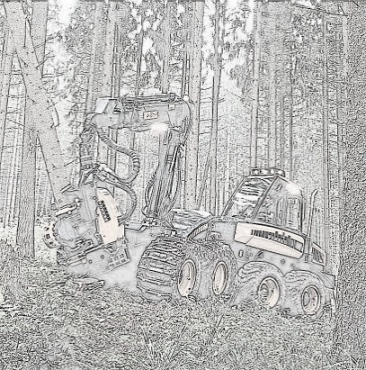
Figure 1b: Illustration of a forwarder loading the logs
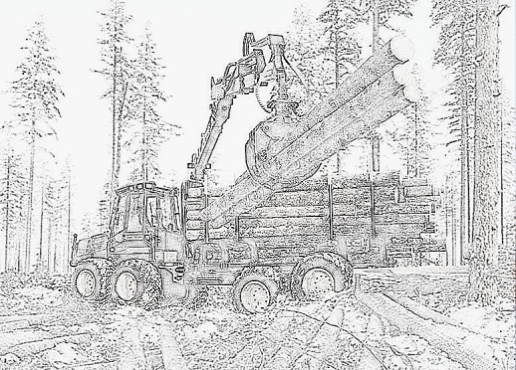
Figure 1c: Illustration of a skidder dragging the trunks of trees
Source: Drawings copyright of K. Ojanen (FIOH), published with special permission in this article.
The cut-to-length method involves two primary machines:
The cut-to-length method reduces manual labour, improves worker safety, and allows for more precise harvesting with less environmental impact (e.g. reduced soil disturbance).
The Full-tree method, most commonly used in North America, involves felling and removing trees from the forest with branches and tops intact. Using the full-tree method, trunks are (pre)limbed mostly by loggers and hauled to the landing/roadside by skidders or cable track to allow truck transport to saw or pulp mills. The skidder differs from the load carrying forwarder so that a skidder drags the timber along the ground, as shown in Figure 1. The load is then dragged to the landing so that the other ends of the stems are trailing the ground. Usually, skidders are four-wheelers and wheel chains can be used on slippery ground.
Mixed stands or stands with broad leaved trees as well as big formatted coniferous trees are processed motor-manually and transported by simple or advanced machine work with skidders. Motor-manual harvesting relies primarily on chainsaws for felling and processing trees and skidders or tractors for extraction. This method involves higher safety risks. However, it can still be used in areas where terrain or economic conditions limit access to large machinery, e.g. in wet and inaccessible forest areas or hilly forests[4].
In the European Union and especially in the Nordic countries, Austria, France and Germany wood is being used as an energy source. Typically, wood from forestry and from wood industry can be used in the form of firewood, wood chips, bark, shavings, briquettes, pellets, and demolition wood. In the EU, woody biomass is the main source of solid biomass accounting for 66% of the total, followed by biomass from organic waste (26%) and biomass from agricultural products (8%) (data for 2021). In particular, the use of wood pellets has increased significantly in recent decades[5].
The traditional forestry bioenergy raw materials are logging residues and small size stems. Stumps and roots of the harvested timber are also used as raw material in the forestry bioenergy.
There are three possible ways to harvest wood for energy from logging residues:
Wood chips or cutter chips are mechanically chopped wood usually up to a length of 15 cm[6]. Most of the logging residues and small size stems are transported loosely to the landing by a forwarder. They can also be baled by a special forestry machine intended for logging residue baling[7]. EU legislation on renewable energy, in particular Directive (EU) 2023/2413[8], sets out rules for sustainable harvesting methods. Harvesting must take into account not only the maintenance of soil quality and biodiversity to minimise negative impacts, but also sustainable forest management to avoid stump and root harvesting, the degradation of primary and old-growth forests or their conversion to plantations, harvesting on fragile soils and minimising the risk of clear-cutting[9].
At the EU level, Council Directive 89/391/EEC[10] sets out the general duties of employers and obliges them to carry out thorough risk assessments and implement prevention measures in line with the hierarchy of controls, which prioritises actions that eliminate or reduce risks at their source. There is no specific EU legislation on OSH in forestry, although there are several directives laying down rules on risk assessment, personal protective equipment, safe use of work equipment, prevention of exposure to chemical, biological and physical agents, etc., all of which apply to work at forest.
European occupational safety and health (OSH) legislation has been transposed to national legislation in each member state, but some countries also have specific OSH forestry legislation. For example, the German statutory accident insurance for agriculture (SVLFG) provides among others guidance and accident prevention regulations for forestry work Unfallverhütungsvorschrift Forsten (Accident prevention regulations for forestry, VSG 4.3)[11].
Accidents in forestry, as in any other industry, can have a wide range of consequences, from fatal accidents, to injuries and lost working days, to minor incidents involving only to material damage and a brief interruption of work. The most hazardous activities are repair and maintenance work, and climbing into and out of the cabin[12] . The table below shows the incidence rate (number of accidents at work per 100 000 workers) for fatal and non-fatal accidents (4 days absence or more) for the three subsectors in the Agriculture, forestry and fishing industry. The incidence rate for all three sub-sectors is well above the average for all sectors, indicating that workers are at higher risk. Forestry work is associated with inherently high occupational health and safety risks, mainly related to the use of heavy machinery, falling trees, weather conditions, noise, vibration, handling of heavy loads, repetitive tasks and exposure to various chemical and biological substances[13].
Table: Accidents at work – Incidence rate – 2010 - 2022
| 2010 | 2014 | 2018 | 2022 | |
| Fatal Accidents | ||||
| Crop and animal production, hunting and related service activities | 3,44 | 4,15 | 4,96 | 4,16 |
| Forestry and logging | 29,15 | 22,75 | 23,53 | 15,64 |
| Fishing and aquaculture | 18,47 | 40,28 | 26,5 | 30,34 |
| All NACE activities | 2,31 | 2 | 1,78 | 1,66 |
| Non-fatal Accidents | ||||
| Crop and animal production, hunting and related service activities | 1.157 | 1.716 | 2.015,74 | 1.597,21 |
| Forestry and logging | 4.874 | 4.103 | 3.121,87 | 2.124,40 |
| Fishing and aquaculture | 2.665 | 4.139 | 3.658,73 | 2.546,15 |
| All NACE activities | 1.799 | 1.706 | 1.669,64 | 1.506,55 |
Source[14]
The following glance at the history of the development of logging operations techniques describes how the profile of risks and accidents has changed with the introduction of different work practices in harvesting/logging operations.
The logging work force increased rapidly after the Second World War in the Nordic countries, especially in Finland, where the main reason was the indemnity to be paid after the war. At the European level, it was the growing need for building material and, in the Nordic countries, the rapidly growing pulp and paper industry. At first, the work was done by axe and hand saw using manpower with forestry transportation done by horses.
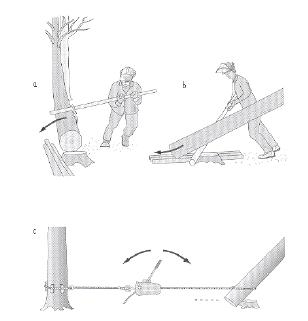
In the 1960s the first chain saws were introduced into forestry harvesting. At that time, logging work was one of the most dangerous occupations. Quite often, the logging areas looked different from today: old forests with dense tree growth. Therefore, while felling a tree, it could get stuck tight against a standing tree (hung-up). Handling hung-up trees down is one of the most risky logging stages[15]. Nowadays, hung-up trees are not a problem when using harvesters for felling. However, accidents can still happen in motor-manual logging. The safest way to take down the hung-up trees is to mark the risky area around it and pull it down when the forwarder comes to the logging site. Figure 2 illustrates how to take a hung-up tree down by using manpower.
Figure 2. Recommended practices for taking down hung-up trees
The most common accidents in those 'axe-saw years' were striking the leg with an axe and different kinds of musculoskeletal disorders. During the 'chain saw decades' most accidents were injuries connected to the chain saw. Chainsaws remain a dangerous tool in forestry and their use is linked to OSH risks including laceration and loss of limbs and health conditions such as hearing loss, whole-body vibration syndrome, traumatic vasospastic disease and musculoskeletal disorders[13] .
When chain saws were introduced, there was no personal protective equipment use. Since the late 1970s, personal protective equipment (PPE) for loggers, such as helmets, ear and eye protection has been gradually introduced. At the same time, OSH legislation increasingly required the use of safe work equipment and the control of residual risks through appropriate PPE. Nowadays, the majority of chainsaw-related accidents occur during leisure time and are typically caused by non-professional loggers, for example farmers[2]. This trend reflects the growing emphasis on skills certification, which underlines the importance of professional competence and adherence to safety and health standards in chainsaw operation. The European certification scheme developed by the European Forestry and Environmental Skills Council (EFESC) outlines different levels of competence and includes structured training programmes.
Mechanisation of logging has had a positive impact on the risks associated with forestry work. From the end of 1970’s onwards the risk levels decreased from being the most accident prone occupation down to average risk levels in the Nordic countries[16]. Eurostat data (see table above) show that both fatal and non-fatal accidents in the forestry sector have fallen sharply since 2010[14]. The decline is also more pronounced in forestry than in other sub-sectors and compared to the average for all sectors. For example, the incidence rate in forestry has halved, while the average has fallen by 30%. However, forest work is still considered one of the most dangerous occupations in the world[17][18]. Although felling and cross-cutting are particularly dangerous tasks, operators of forestry tractors (forwarders) are also at risk, especially when repairing and maintaining forestry tractors on work sites. In recent decades, machinery has become more and more reliable, reducing the need for repair and maintenance work and, consequently, the number of occupational accidents. Also climbing into and getting out of the cabin of the forwarder or harvester may lead to injuries Too often, the operator jumps out of the cabin to the rough terrain or/and slippery (e.g. snow, branch strewn) ground.
Mechanisation of forestry operations reduces manual labour and the risk of musculoskeletal disorders (MSDs). A study among Greek forestry workers[19] found a high prevalence of MSDs among those using the motor-manual method, particularly in the lower back and shoulder. However, replacing a motor-manual system with a fully mechanised system shifts the workload from physical to mental workload and the vibration from hand-arm to whole-body vibration[20]. Hand-arm vibrations in forestry are generated by hand-held tools and machines such as chainsaws or stump grinders. Whole-body vibration is of particular concern in highly mechanised systems, where operators of forestry tractors (forwarders) are at risk.
A further step in the mechanisation includes advances in remote-controlled machines and autonomous harvesting[13] . The use of such technologies and machines will reduce risks associated with tree harvesting such as such as the use of chainsaws, vibration and noise[13] .
Wood transport is the link between forest harvesting and the sawmills or pulp factories. Wood transport includes loading, transporting and unloading of wood logs. Even if fully mechanised, loading and unloading remain hazardous. It may be done on landings or at roadside. Landing area brings together ground workers, machines and vehicles. Here different operations such as delimbing, debarking, storing, chipping, loading and unloading are performed and should be carefully managed[21].
Wood transport itself includes a drive on an unsealed forest road, then a journey on a narrow local road before getting on the national roads for most of the journey. The transport of timber on public roads is subject to road safety legislation. Special attention should be given to cargo securing. It is very important that vehicles are loaded safely and load is safe and secure for transport to avoid injury to the operator, the public and other road users. Longitudinal loading of roundwood can increase the risk of the log moving forward and possibly hitting the cab and injuring the driver in the event of sudden braking. The load restraint system must be sufficient to stop the total weight of the load moving forwards under severe braking, The UK Code of practice for road haulage of round timber requires that ‘all loads of roundwood timber longer than 3.3m should be secured with at least two correctly rated straps’[22]. Further information is also available in the European Best Practice Guidelines on Cargo Securing for Road Transport[23].
The growing use of forest biomass increases exposure to biological agents. Forestry bio(energy)mass e.g., stumps, small size stems and logging residues (limbs and tops) are stored at the roadsides to allow them to dry. The storage period is about one year. If the conditions are poor (e.g. rainy summer) mould and fungi can start growing and may put workers at risk.
During the process of harvesting forest biomass, machinery is used such as woodchippers.
Workers working with chipping machines are exposed to high noise levels, whole body vibrations as well as hand-arm vibrations and wood dust[24]. Health risks associated with exposure to wood dust include respiratory problems, allergies and dermatoses. Some types of wood dust are considered to be carcinogenic[24].
The impact of climate change on the working environment is creating new challenges and increasing the risks faced by forest workers[25]. More extreme weather events will lead to more adverse and unsafe working conditions. For example, clearing wind-blown trees poses significant safety risks[25] due to the unstable nature of fallen and potentially still standing trees. Wind-blown trees can be under significant tension or compression, and releasing this stored energy by cutting can cause violent movement, injury or crushing. In addition, hidden debris, hanging trees and potential damage to utilities add to the hazards[26].
Climate change is also causing average temperatures to rise, exposing forest workers to hotter conditions and periods of heat waves more frequently. Working in extreme heat can lead to dehydration, heat exhaustion and heat stroke. The use of PPE in extreme heat conditions is particularly challenging, especially in forestry, adding to the already high work intensity and workload[25].
Milder winters also affect the spread of animal and insect-borne diseases. For example, tick-borne diseases such as Lyme disease and tick-borne encephalitis continue to spread westwards from Central and Eastern Europe[25].
In addition, studies show that the stress placed on foresters by climate change is also linked to mental health problems such as anxiety, mood disorders, stress, depression and feelings of hopelessness[27]. Adverse climatic changes have also been linked to fear, despair, suicidal thoughts, increased drug abuse and heat-related deaths. However, the relationship between climate change and the mental health of forestry workers is still under-researched[27].
The integration of digital technologies is transforming traditional forestry practices. Innovations such as drones and remote sensing are increasingly used to monitor forest growth, assess stand conditions, and optimise harvesting operations. Modern forestry equipment can be equipped with advanced sensors for navigation, environmental monitoring, and real-time data collection, enabling more efficient and remote management of harvesting activities[28].
Digital technologies can also play a role in improving the health and safety of forest workers. For instance, GPS-enabled devices and mobile applications can track the location and movement of lone workers, with automated emergency alerts triggered in case of accidents or inactivity. Additionally, smart personal protective equipment (PPE), smartwatches, and other wearable technologies can monitor vital signs such as heart rate and body temperature for early detection of conditions like heat stress or fatigue.
While these technologies offer benefits, they can also introduce new risks or increase existing ones. Their implementation must therefore be accompanied by risk assessments, appropriate training and transparent procedures[27].
Managing OSH in forestry is aimed at:
OSH management requires the development of OSH policies and action plans. A policy should be concrete, be easy to understand, and be supported by key performance indicators. These policies must be clearly communicated. Action plans should be based on risk assessments, clearly describe practical measures and indicate who is responsible. This step is important especially since the wood harvesting work site is often a shared workplace where contractors and subcontractors are working together, and smooth communication is needed to guarantee a safe working environment.
The first step of risk assessment is to identify the hazards and to identify workers who may be exposed to the hazards. Special attention is needed for vulnerable workers such as young, older and migrant workers, The risk assessment process also needs to be comprehensive and include all work activities. For example, during logging operations or loading and unloading of timber, what hazards are associated with the available machines and tools, what are the characteristics of the workers, what are their qualifications etc.).
The second step is to evaluate the risks and to prioritise them in order of importance. Main categories to classify the priority of preventive measures according to the probability and severity are:
For instance, risks associated with working with forest machinery may include prolonged awkward work postures, repetitive work, sustained high levels of attention, whole body vibration, jolts and bumping. Aggravating circumstances can be working alone, working in the dark, shift work, unclear instructions, poor equipment, and working under pressure. When purchasing a forestry tractors or other forestry machinery, it's important to take into account the EU safety and health requirements (CE mark)[29] and consider ergonomic aspects improving the comfort of the driver and reducing health complaints.
The third step of risk assessment is to decide on preventive actions. Appropriate measures to eliminate or control the risks have to be identified. Examples of preventive measures are micro pauses and rest breaks, evaluating and modifying working postures, training in working techniques, and reducing machine (operating) hours, and aiming for job enlargement.
The fourth step is to take action by putting in place the preventive and protective measures through a prioritisation plan. Furthermore, documentation of the activities, the goal and key performance indicators, scheduling, responsibilities and budgeting is needed.
Finally, according to the principle of continuous improvement, follow up is essential. For example, through an assessment of work organisation and job satisfaction, by measuring health and safety performance indicators like accidents, diseases or other health problems, assessment of work shift rosters. In addition, costs for ill-health and preventive measures can be estimated and, making strengths and weaknesses in the work conditions visible.
Promoting OSH and improving safety performance in the forestry sector can be achieved by fostering a robust safety culture in which OSH is embedded at every level of the organisation and in all work activities[30]. This requires strong, visible leadership commitment, active worker participation and well-structured action plans that support continuous learning and improvement. Initiatives such as the Safety Culture and Risk Management in Agriculture (SACURIMA)[31] and Vision Zero (ISSA)[32] have developed recommendations and guidance towards a safety culture in agriculture.
Traditionally, the forest has been considered a dangerous workplace. It differs substantially from the indoor workplace of an industrial worker. Climate, terrain conditions, and a great variation in the forest stands are challenges to the forest worker.
The introduction of machines into the wood harvesting business has led to rapid changes in the way these operations are organised. Advances in forest harvesting machines with today’s mechanised systems have been instrumental in a development where 'contractors' take more responsibility for the harvesting operations and the forest companies are increasingly dependent on contracting businesses, i.e. not carrying out the actual forest work themselves.
In addition to organisational changes of work, the introduction of machines and digital technologies has altered the working conditions. The working environment is now much easier to control in order to reduce the traditional accident hazards. However, other hazards may still exist.
[1] Eurostat. Forests, forestry and logging. Statistics explained, December 2024. Available at: https://ec.europa.eu/eurostat/statistics-explained/index.php?title=Forests,_forestry_and_logging
[2] EU-OSHA – European Safety and Health at Work Agency. Occupational safety and health in Europe’s forestry industry. E-fact 29, 2008. Available at: https://osha.europa.eu/en/publications/e-fact-29-occupational-safety-and-health-europes-forestry-industry
[3] Lundbäck, M.; Häggström, C.; Nordfjell, T. Worldwide trends in the methods and systems for harvesting, extraction and transportation of round wood. Proceedings of the 6th international forest engineering conference, April 16–19 2018, University of Canterbury: Rotorua, New Zealand. 2018, p. 1–3, cited in Korneeva, Y., Shadrina, N., Simonova, N., & Trofimova, A. (2024). Job stress, working capacity, professional performance and safety of shift workers at forest harvesting in the North.
[4] Lewark, S., ed., Scientific reviews of ergonomic situation in mechanized forest operations. Swedish University of Agricultural Sciences. Survey 2, 2005.
[5] EU Commission. Report on bioenergy sustainability. Annex to the Report from the Commission to the European Parliament, the Council, the European Economic and Social Committee and the Committee of the Regions. State of the Energy Union Report 2023. Available at: https://energy.ec.europa.eu/publications/report-bioenergy-sustainability_en
[6] Rubick, A., Englisch, M., A strategy for the sustainable use of wood and its implementation as base for legislative measures on regional level, Grant agreement number EIE/06/191/SI2.448381, Deliverable D.3.4. Concept for raw material collection and processing, Astwood project, Intelligent Energy Europe, 2008, pp. 1-66.
[7] Metsäteho Oy, 'Hakkuutähteen paalauksen ja paalien metsäkuljetuksen tuottavuus', (The baling and forestry transportation of the logging residues; in Finnish), Tutkimusraportti 179, 11.8.2004.
[8] Directive (EU) 2023/2413 of the European Parliament and of the Council of 18 October 2023 amending Directive (EU) 2018/2001, Regulation (EU) 2018/1999 and Directive 98/70/EC as regards the promotion of energy from renewable sources, and repealing Council Directive (EU) 2015/652. Available at: http://data.europa.eu/eli/dir/2023/2413/oj
[9] Bioenergy Series – How is forest biomass affected by RED III? Available at: https://www.hfw.com/app/uploads/2024/05/005968-HFW-Bioenergy-Series-How-Is-Forest-Biomass-Affected-By-Red-III.pdf
[10] Council Directive 89/391/EEC of 12 June 1989 on the introduction of measures to encourage improvements in the safety and health of workers at work. Available at: https://osha.europa.eu/en/legislation/directives/the-osh-framework-directive/1
[11] Unfallverhütungsvorschrift Forsten (VSG 4.3) vom 1. Januar 2000 Ausgabe 1. Januar 2017. Available at: https://cdn.svlfg.de/fiona8-blobs/public/svlfgonpremiseproduction/5eef1437acda7060/19bb627832ef/vsg4_3-forsten.pdf
[12] Johansson, J., Pontén, B., Coordinate work-injury statistics at larger forest companies, In: Lewark, S. (ed.), Scientific reviews of ergonomic situation in mechanized forest operations, Swedish University of Agricultural Sciences, Survey 2, 2005.
[13] FAO, ILO & United Nations. 2023. Occupational safety and health in the future of forestry work. Forestry Working Paper, No. 37. Rome. Available at: https://doi.org/10.4060/cc6723en
[14] Eurostat. Non-fatal accidents at work by NACE Rev. 2 activity and sex (hsw_n2_01), Fatal Accidents at work by NACE Rev. 2 activity (hsw_n2_02)
[15] ILO – International Labour Office, Safety and health in forestry work, ILO code of practice, Geneva, 1998. Available at: https://www.ilo.org/sites/default/files/wcmsp5/groups/public/@ed_protect/@protrav/@safework/documents/normativeinstrument/wcms_107793.pdf
[16] Finnish Occupational Safety and Health Administration, Tapaturmat ja ammattitaudit (Accidents and occupational diseases, in Finnish), 2011.
[17] Klun J., Medved M., Fatal accidents in forestry in some European countries, Croatian Journal of Forest Engineering 28, no 1, 2007.
[18] Garland J., Cedergren J., Eliasson L., van Hensbergen, H., McEwan, A. and Wästerlund, D. 2020. Occupational safety and health in forest harvesting and silviculture – A compendium for practitioners and instructors. Forestry Working Paper No. 14. Rome, FAO. Available at: https://doi.org/10.4060/ca8773en
[19] Dimou, V., Malesios, C., & Pispa, S. (2020). Assessing forestry-related musculoskeletal symptoms in specific body areas. International Journal of Forest Engineering, 31(3), 233-241.
[20] Bačić, M., Landekić, M., Pandur, Z., Šušnjar, M., Šporčić, M., Nevečerel, H., & Lepoglavec, K. (2024). Forestry Ergonomics Publications in the Last Decade: A Review. Forests, 15(4), 616.
[21] Olli, E., Timber Transport, Encyclopedia of Occupational Health and Safety, Jeanne Mager Stellmann, Editor in Chief. International Labour Organisation, chapter 68. Forestry, 2011.
[22] Timber Transport Forum (2020). The Road Haulage of Round Timber Code of Practice (5th Edition). Available at: https://timbertransportforum.org.uk/wp-content/uploads/2021/11/Timber-Transport-Forum-Road-Haulage-of-Round-Timber-5-Ed-Digital.pdf
[23] European Commission: Directorate-General for Mobility and Transport, Cargo securing for road transport – 2014 European best practices guidelines, Publications Office, 2014, Available at: https://data.europa.eu/doi/10.2832/80373
[24] Gejdoš, M., & Lieskovský, M. (2024). Overview of Health and Safety Risks in the Process of Production and Storage of Forest Biomass for Energy Purposes—A Review. Energies, 17(5), 1064.
[25] EU-OSHA – European Agency for Safety and Health at Work. Agriculture and forestry: how climate change is creating new and emerging OSH risks. Policy brief, 2021. Available at: https://osha.europa.eu/en/publications/agriculture-and-forestry-how-climate-change-creating-new-and-emerging-osh-risks
[26] Suva (2003). Dealing with windblown trees. Brochure. Swiss National Accident Insurance Fund. Available at: https://www.waldwissen.net/en/technique-and-planning/forest-technology/safety-at-work/dealing-with-windblown-trees
[27] EU-OSHA – European Agency for Safety and Health at Work. The future of agriculture and forestry: implications for managing worker safety and health. Report, 2020. Available at: https://osha.europa.eu/en/publications/future-agriculture-and-forestry-implications-managing-worker-safety-and-health
[28] UNECE. Trends in Digitalization of the Forest Sector. Available at: https://land.unece.org/forests/en/knowledge-hub/forest-information-systems/trends-digitalization-forest-sector
[29] European Commission. Directives and regulations on wheeled agricultural or forestry tractors. Available at: https://single-market-economy.ec.europa.eu/sectors/automotive-industry/legislation/wheeled-agricultural-or-forestry-tractors_en
[30] Linden, A., Ulvenblad, P., & Barth, H. (2025). Safety culture co-creation in forest industry manufacturing mills–A systematic literature review and conceptual model. Journal of Forest Business Research, 4(2), 1-46.
[31] COST Action. Improving health and safety in European agriculture with SACURIMA. Available at: https://www.cost.eu/agriculture-sacurima/
[32] Vision Zero - Guide for agriculture company. Available at: https://visionzero.global/node/313
EU-OSHA – European Safety and Health at Work Agency. Occupational safety and health in Europe’s forestry industry. E-fact 29, 2008. Available at: https://osha.europa.eu/en/publications/e-fact-29-occupational-safety-and-health-europes-forestry-industry
EU-OSHA – European Agency for Safety and Health at Work. The future of agriculture and forestry: implications for managing worker safety and health. Report, 2020. Available at: https://osha.europa.eu/en/publications/future-agriculture-and-forestry-implications-managing-worker-safety-and-health
EU-OSHA – European Agency for Safety and Health at Work. Agriculture and forestry: how climate change is creating new and emerging OSH risks. Policy brief, 2021. Available at: https://osha.europa.eu/en/publications/agriculture-and-forestry-how-climate-change-creating-new-and-emerging-osh-risks
EC – European Commission. Protecting health and safety of workers in agriculture, livestock farming, horticulture and forestry. Guideline, 2012. Available at: https://osha.europa.eu/en/publications/protecting-health-and-safety-workers-agriculture-livestock-farming-horticulture-and
FAO, ILO & United Nations. 2023. Occupational safety and health in the future of forestry work.
Forestry Working Paper, No. 37. Rome. Available at: https://doi.org/10.4060/cc6723en
Tema seçin