


Preventing accidents and incidents is an important objective of occupational safety and health (OSH) management. However, the concept of an accident is defined differently depending on the context in which it is used. Despite these different definitions, European statistics are available that provide more insight into the number of work-related accidents and on their causes and circumstances
The terms accident and incident at work are defined in different ways depending on the context and purpose. Common definitions are those used in OSH management, workers’ compensation systems, and statistical reporting.
In the context of OSH management, the phenomenon of accidents and incidents is often viewed in light of accident investigation and analysis. The main purpose is to gain insight in the (underlying) causes in order to prevent accidents in the future and to improve the safety of the workers. Definitions of accidents and incidents reflect this purpose and refer in one way or another to how accidents occur.
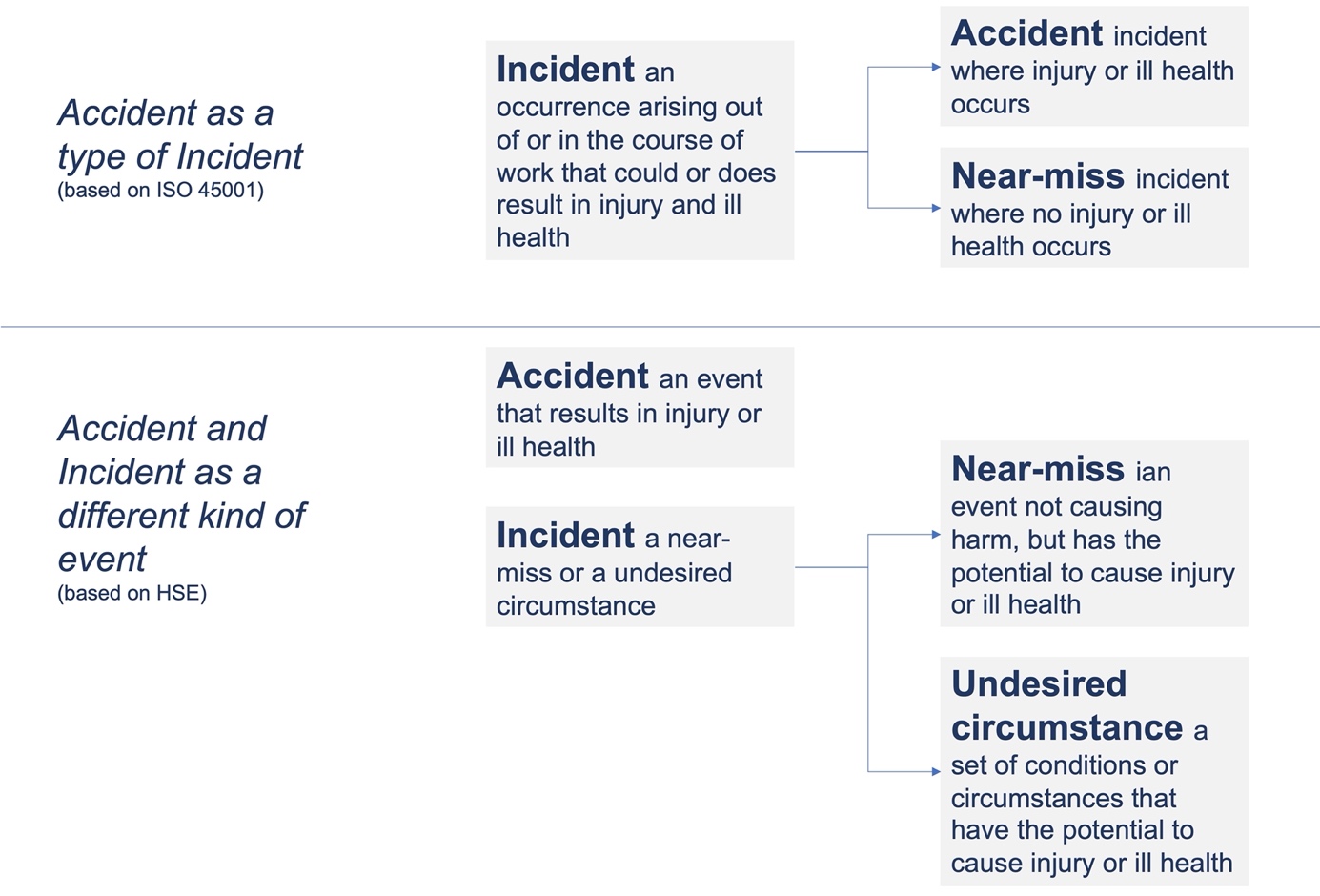
Figure 1: Definitions of accident and Incident
The definition of an accident provided by Heinrich in the 1930s is often cited. Heinrich defines an accident as an unplanned and uncontrolled event in which the action or reaction of an object, substance, person or radiation results in personal injury or the probability thereof. Variations on this definition can be found throughout the safety literature. Bird and Germain for instance define an accident as an unintended or unplanned happening that may or may not result in property damage, personal injury, work process stoppage or interference, or any combination of these conditions under such circumstances that personal injury might have resulted[1].
More recent literature, often argues that the terms "unplanned", "uncontrolled" are misleading. These terms might imply that the event is related to fate or chance and cannot be controlled. However, accident investigations show that many events were predictable and could have been prevented had the right actions been taken. This suggests that the event is not one of fate or chance.
Most contemporary definitions don't include the notion "unplanned" and/or speak in more general terms of "incident" instead of accident. The ISO 45001 standard focuses on the definition of an incident[2]. An incident is referred to as an occurrence arising out of or in the course of work that could or does result in injury and ill health. An accident is regarded as a particular type of incident in which an injury or ill health actually occurs. A near-miss is an incident where no injury or ill health occurs. Therefore, an incident can be either an accident or a near-miss.
Although the term incident is regarded more and more as a broad term encompassing all events causing injury or material damages and also near-miss events, this is not always the case. Incident is often also referred to, as an event that has the potential to cause harm, but didn't. Incident is then regarded as a synonym for a near-miss event[3]. These differences in terminology and definitions have to be taken into account when browsing through safety literature or when looking into accident investigation techniques.
In the context of workers' compensation systems the definition of an accident at work forms the basis for determining the eligibility of a work-related event for compensation[4]. Workers' compensation schemes differ from country to country within the EU. Therefore, the definition of 'accident' varies, but in general it refers to a sudden event at the workplace or during work activity that causes an injury[4]. Most workers' compensation systems presume that if an injury arises out of and in the course of the employment, the victim is entitled to receive the appropriate benefits. Also, injuries that result from commuting to and from work are covered in several workers' compensation schemes[5] (e.g. Belgium[6], Finland[7]).
For example, in Belgium the definition of an occupational accident is based on six elements[6]:
The fact that occupational accidents are sudden events allows making a distinction between accidents and diseases. Diseases are usually caused by a process extended over a longer period of time and not by a sudden event. Although this distinction seems straightforward it is not always the case. For instance, back problems can be the result from prolonged exposure or be linked to a sudden event.
The definition of an occupational accident also includes the fact that the accident has to arise out of work performed in the course and the scope of employment. This criterion often leads to discussions about accidents during activities in the workplace where the link with the scope of employment is somewhat questionable e.g. during excursions, The criterion injury may comprise not only bodily harm, but also mental health problems caused by an accident.
Finally, the concept of an occupational accident is based on the fact that there has to be a causal link between the event and the injury. Only direct consequences of the occupational accident are eligible for compensation.
Although statistical data on accidents at work are often based on data provided by Workers' Compensation Systems, the definition should be considered from a different perspective. The question is not whether the victim should be compensated, but whether the event should be registered as an accident at work for statistical purposes such as identifying trends or making comparisons.
The definition used in the European Union is developed by Eurostat in the framework of ESAW, European Statistics on Accidents at Work[8]and included in annex IV of Regulation 1338/2008/EC[9]. This Regulation states that Member States are obliged to gather data on accidents at work based on the ESAW framework and provide these data to Eurostat.
ESAW defines an accident at work as a discrete occurrence in the course of work which leads to physical or mental harm[8]. This includes cases of acute poisoning and wilful acts of other persons, as well as accidents occurring during work but off the company’s premises, even those caused by third parties. It excludes deliberate self-inflicted injuries, accidents on the way to and from work (commuting accidents), accidents having only a medical origin and occupational diseases.
The phrase in the course of work means whilst engaged in an occupational activity or during the time spent at work. This includes cases of road traffic accidents in the course of work.
A fatal accident is defined in ESAW as an accident leading to the death of a victim within one year of the accident. A commuting accident is defined as an accident that occurs during the normal journey between the home, the place of work and the usual place where meals are taken. Only accidents at work with an absence of more than three calendar days are included in the ESAW data. This means that an accident at work is included in the ESAW database if the person is unfit for work for more than three days, excluding the day of the accident. Consequently, ‘more than three calendar days’ means ‘at least four calendar days’. Only full calendar days (not only working days) of absence from work have to be considered[8].
Table: Overview of definitions, depending on context and purpose
| Context | Purpose | Definition |
| OSH management | prevent/control risks: gain insight in the (underlying) causes in order to prevent accidents in the future and to improve the safety of the workers | Incident = occurrence arising out of or in the course of work that could or does result in injury and ill health. Accident = an incident in which an injury or ill health actually occurs. Near-miss = an incident where no injury or ill health occurs[2]. |
| Workers’ compensation systems | basis for determining the eligibility of a work-related event for compensation | Occupational accident = sudden event at the workplace or during work activity that causes an injury[4]. |
| Statistical reporting | Analysis of trends | An accident at work is defined as a discrete occurrence in the course of work which leads to physical or mental harm[8]. |
Data on accidents at work are available through national reporting systems (e.g. accident insurers) or through surveys. The European Labour Force Survey (EU-LFS) ad hoc module 2007, 2013 and 2020 provides data on self-reported occupational accidents in the year preceding the survey, irrespective of whether these accidents resulted in absence from work. ESAW, the European Statistics on Accidents at Work, is based on reporting systems from the Member States and includes data on accidents at work with more than three days of absence from work (non-fatal accidents) and fatal accidents. The Member States provide yearly statistics to Eurostat. The ESAW data and the results from the EU-LFS are available in data tables in the data browser from Eurostat[10]. The overview below is based on these data tables.
In 2022, there were 2,97 million non-fatal accidents that resulted in at least four calendar days of absence from work and 3 286 fatal accidents in the EU[11]. The overall trend shows that accidents at work are decreasing, not only in absolute numbers but also the incidence rate (table 1). The incidence rate expresses the number of accidents in relation to the number of persons employed (100 000). The decreasing trend of accidents can be linked to changes in the world of work with an employment shift from traditionally high-risk sectors such as agriculture or mining to more service-oriented sectors.
Table 1: Non-fatal and fatal accidents at work – 2010 – 2023 (ESAW)
| EU-27 | 2010 | 2013 | 2016 | 2019 | 2022 |
|---|---|---|---|---|---|
| Non-fatal accidents | |||||
| Number | 2.682.716 | 2.300.130 | 2.293.808 | 2.374.139 | 2.164.017 |
| Incidence rate | 2.021,24 | 1.871,61 | 1.821,38 | 1.742,97 | 1.550,69 |
| Fatal accidents | |||||
| Number | 3.810 | 3.030 | 2.965 | 3.008 | 2.932 |
| Incidence rate | 2,87 | 2,47 | 2,35 | 1,9 | 2,1 |
Source: table compiled based on[12]
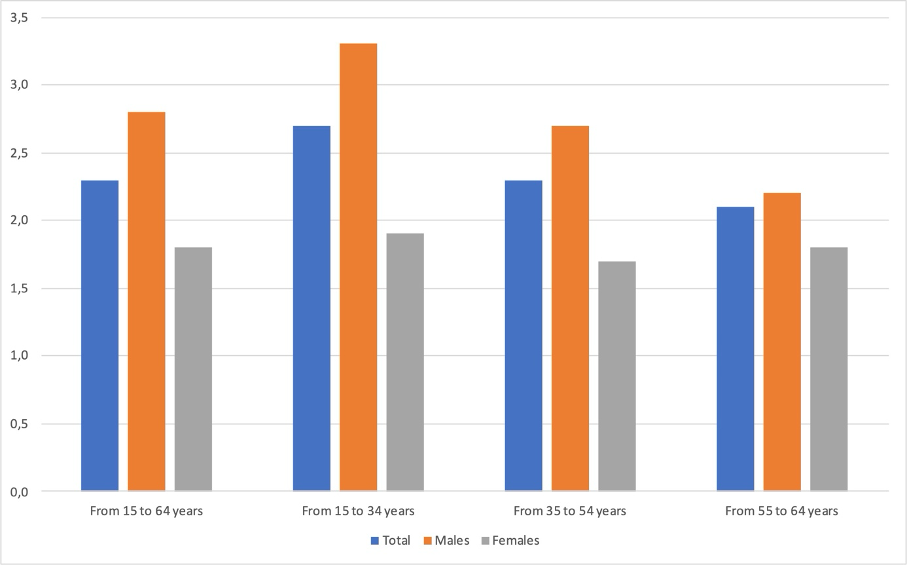
Men are more often victim of an accident at work than women. The LFS data from 2020 show that on average 2.8% of the male employed persons reported having a work accident during the last year compared to 1.8% of the female employed persons[13]. Young, male workers are most at risk (figure 2).
Figure 2: % of persons reporting an accident at work according to age and sex (EU-LFS 2020)
Source: figure compiled based on[13]
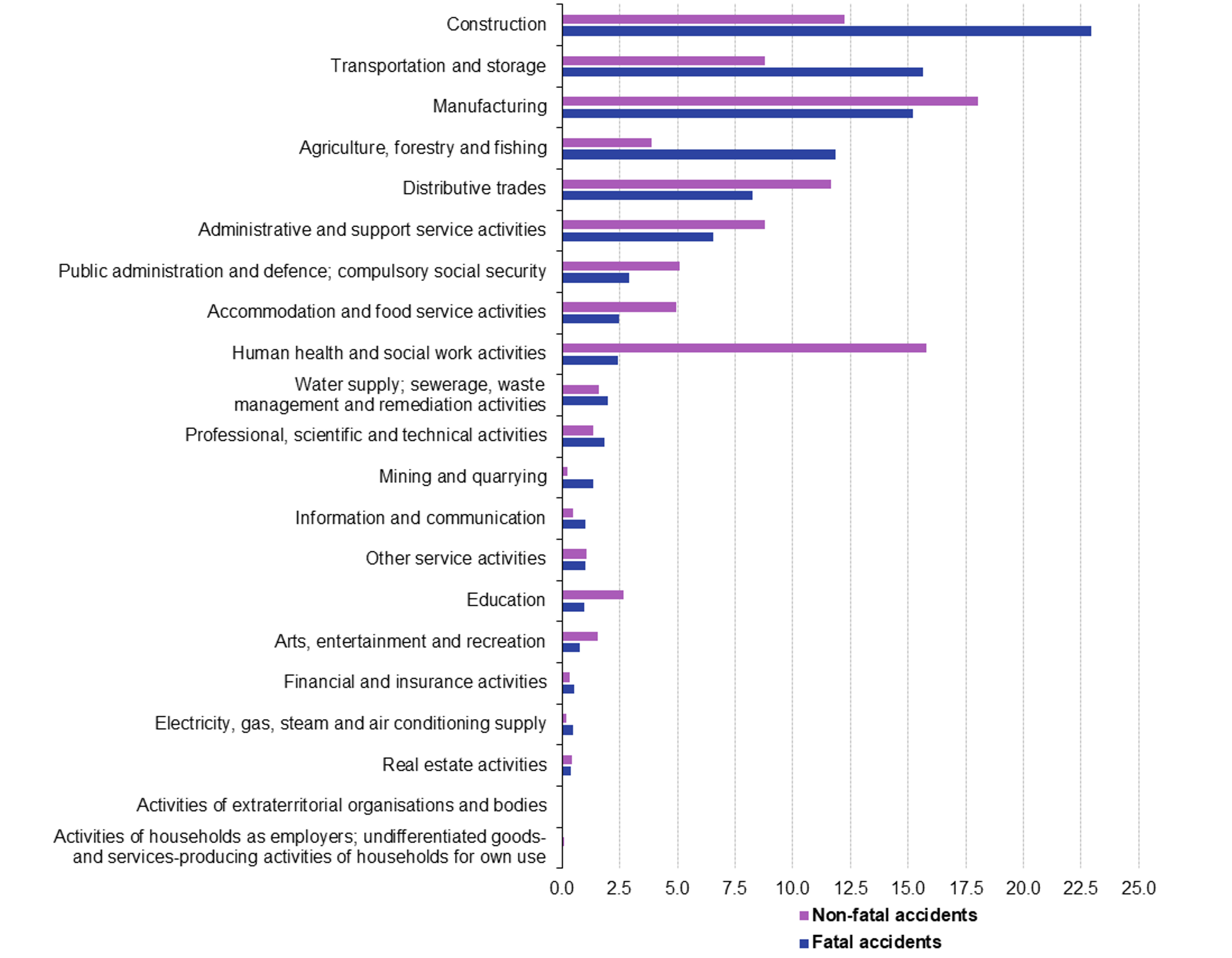
The sectors with the most non-fatal accidents (in numbers) are manufacturing (18.0% of the EU total in 2022), human health and social work activities (15.8%), construction (12.2%) and distributive trades (11.7%)[11].
Almost a quarter (22.9%) of all fatal accidents in the EU occurred in the construction sector, while transportation and storage accounted for the next highest proportion (15.6%). The other activity sectors with a share of more than 10% of the total number of fatal accidents were manufacturing (15.2%) and agriculture, forestry and fishing (11.8%)[11].
Figure 3: Fatal and non-fatal accidents at work by NACE section, EU, 2022 (% of fatal and non-fatal accidents)
Source[11]
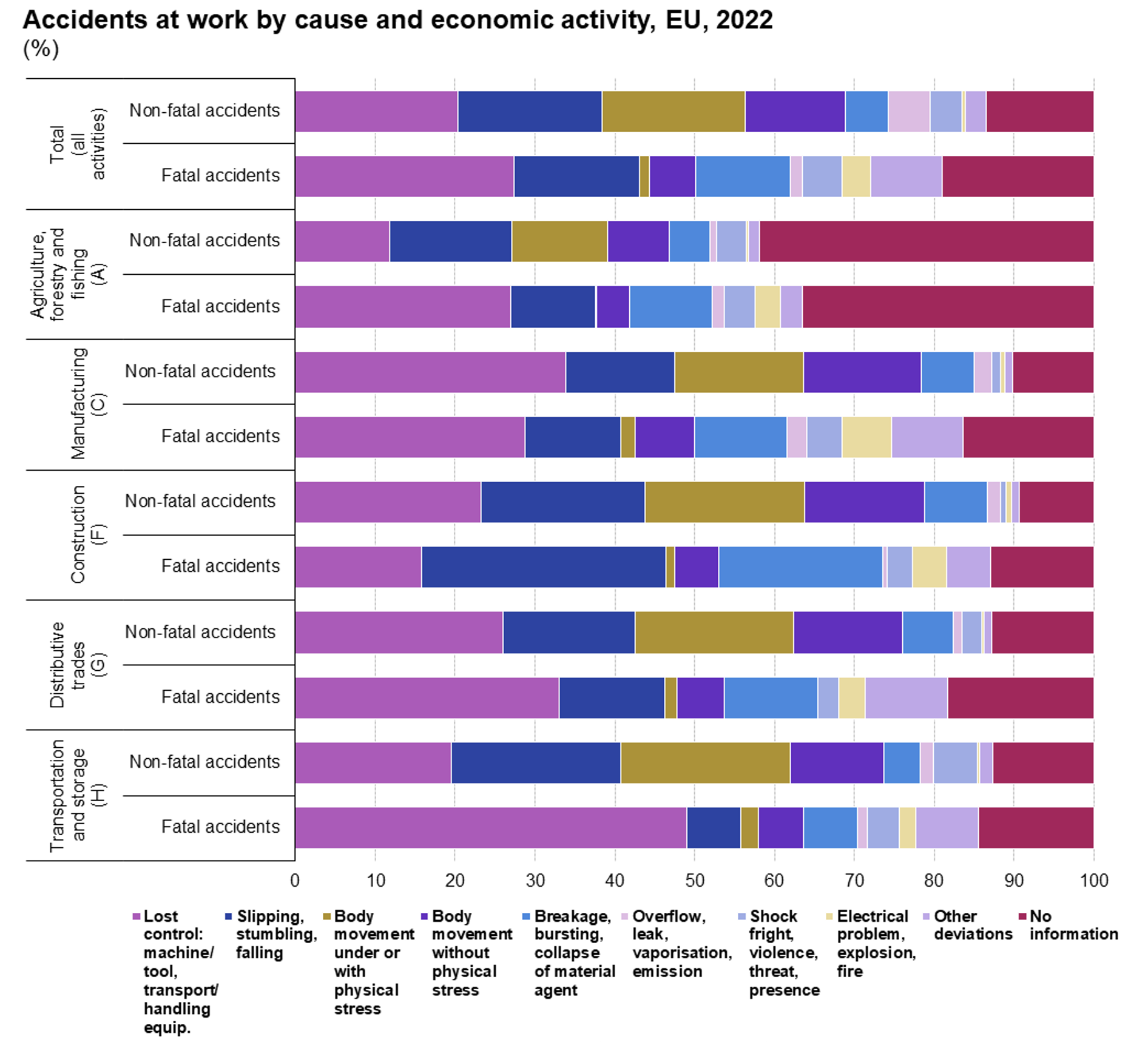
The ESAW methodology describes the accident cause as the last event differing from the norm that resulted in an accident. In 2022, the most common causes of non-fatal accidents at work in the EU included losing control of machines, tools or transport and handling equipment (20.3 %), body movement under or with physical stress (18.0 %), and slipping, stumbling or falling (18.0 %). Losing control of machines, tools or transport and handling equipment (27.4 %) was also the most frequent cause of fatal accidents at work, followed by Slipping, stumbling or falling (15.6 %) and Breakage, bursting or collapse of material agents (11.9 %). More detailed data by cause and sector show the correlation between activities and causes. For instance, in the Transportation and storage sector Losing control of machines, tools or transport and handling equipment account for almost 1 out of 2 fatal accidents. In the Construction sector Slipping, stumbling and falling is the most common cause of fatal accidents (figure 4).
Figure 4: Accidents at work by cause and economic activity - % (ESAW)
Source[11]
The most obvious consequence of accidents is the fact that they result in absence from work. Data show that almost 50% of accidents at work result in less than 14 days absence from work.
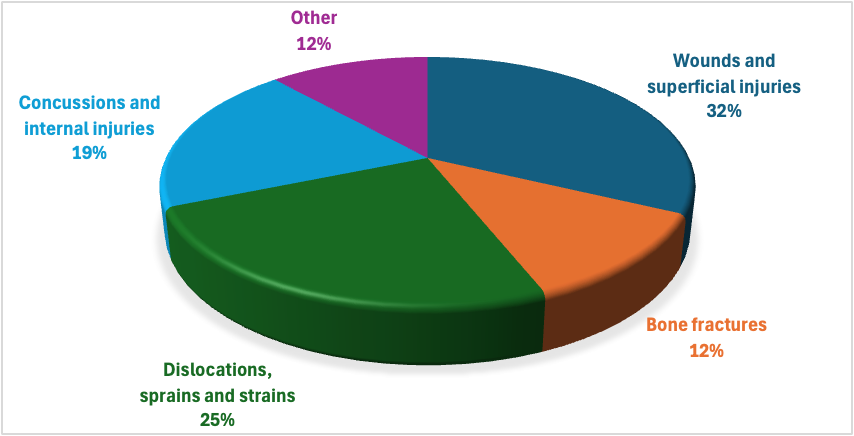
The most common types of injury that result from accidents are Dislocations, sprains and strains and Wounds and superficial injuries followed by Concussions and Bone fractures (figure 5). All other types of injuries account for 12% of all accidents at work.
Table 2: Accidents at work by days lost – 2022 (ESAW)
| Number | Percentage | |
| From 4 to 6 days | 377.998 | 17,44% |
| From 7 to 13 days | 579.956 | 26,76% |
| From 14 to 20 days | 302.646 | 13,97% |
| From 21 days to 1 month | 214.625 | 9,90% |
| From 1 to 3 months | 405.362 | 18,71% |
| From 3 to 6 months | 124.264 | 5,73% |
| Permanent incapacity or 183 days or over | 99.961 | 4,61% |
| Fatal | 2.932 | 0,14% |
| Total | 2.166.948 |
Source: table compiled based on[14]
Figure 5: Accidents at work by type of injury - % - 2022 (ESAW)
Source: figure compiled based on[15]
[1] Bird, F., Germain, G., A new horizon in accident prevention and cost improvement, New York, 1966.
[2] ISO 45001:2018 Occupational health and safety management systems — Requirements with guidance for use
[3] HSE – Health and Safety Executive, Accidents and investigations. Available at: https://www.hse.gov.uk/pubns/books/hsg245.htm
[4] Walters, D., & Work, C. (2007). An international comparison of occupational disease and injury compensation schemes. Industrial Injuries Advisory Council.
[5] ILO Encyclopeadia of Occupational Health and Safety. Worker's Compensation Systems, ed.: Ison, T. Available at: https://www.iloencyclopaedia.org/part-iii-48230/workers-compensation-systems
[6] Federal Public Service Employment, Labour and Social Dialogue, Occupeational accidents. Available at: https://employment.belgium.be/en/themes/well-being-workers/occupational-accidents
[7] Finnish Workers’ Compensation Centre, What is an occupational accident? Available at: https://www.tvk.fi/en/compensation/occupational-accident/
[8] European Commission, European statistics on accidents at work (ESAW), Methodology, 2013 Available at: https://ec.europa.eu/eurostat/en/web/products-manuals-and-guidelines/-/KS-RA-12-102
[9] Regulation (EC) No 1338/2008 of the European Parliament and of the Council of 16 December 2008 on Community statistics on public health and health and safety at work. Available at: http://data.europa.eu/eli/reg/2008/1338/oj
[10] Eurostat, database. Available at: https://ec.europa.eu/eurostat/web/main/data/database
[11] Eurostat. Accidents at work statistics. Statistics explained. Available at: https://ec.europa.eu/eurostat/statistics-explained/index.php?title=Accidents_at_work_statistics
[12] Eurostat, Accidents at work by sex, age and severity (NACE Rev. 2 activity A, C-N) (hsw_mi01). Available at: https://doi.org/10.2908/HSW_MI01
[13] Eurostat, Persons reporting an accident at work by sex, age and professional status (hsw_ac8). (LFS 2020). Available at: https://doi.org/10.2908/HSW_AC8
[14] Eurostat, Accidents at work by days lost, sex and age (NACE Rev. 2 activity A, C-N) (hsw_mi02). Available at: https://doi.org/10.2908/HSW_MI02
[15] Eurostat, Accidents at work by type of injury and severity (NACE Rev. 2 activity A, C-N) (hsw_mi07). Available at: https://doi.org/10.2908/HSW_MI07
EU-OSHA – European Agency for Safety and Health at Work. Occupational safety and health in Europe: state and trends 2023. Report, 2023. Available at: https://osha.europa.eu/en/publications/occupational-safety-and-health-europe-state-and-trends-2023
EU-OSHA – European Agency for Safety and Health at Work. OSH Barometer https://osha.europa.eu/en/facts-and-figures/data-visualisation/osh-barometer-data-visualisation-tool
EU-OSHA – European Agency for Safety and Health. Accident prevention. Report, 2001. Available at: https://osha.europa.eu/en/publications/report-accident-prevention-practice
ILO - International Labour Organisation. Statistics on safety and health at work. https://ilostat.ilo.org/topics/safety-and-health-at-work/
ILO, Reporting, Recording, and Notification of Occupational Accidents and Diseases: A brief guide for Employers and Managers. Available at: https://www.ilo.org/global/topics/safety-and-health-at-work/resources-library/training/WCMS_819065/lang--en/index.htm
ILO, Investigation of occupational accidents and diseases : a practical guide for labour inspectors. Available at: https://labordoc.ilo.org/discovery/fulldisplay/alma994870783402676/41ILO_INST:41ILO_V2
Välj ämne