


Nearly all industries, including the agri-food industry and the service industry, use chemicals in variable amounts and must therefore store them, as well as the produced chemical waste before disposal. Safe storage of chemicals is fundamental to prevent risks to the health and safety of workers and damage to the environment. While designing a chemical storage facility, regardless of its size, it is thus essential to take into account all hazardous properties of chemicals, whether they are intrinsic or arise from interactions with other chemicals or the gases and aerosols in the workplace atmosphere.
Picture 1: A chemical storeroom
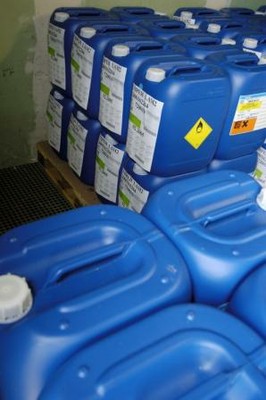
Toxicological, chemical and physical properties define the hazards of a chemical. However, in a chemical storage facility additional risk factors influence the risk such as quantity, storage form, proximity of various chemicals, activities carried out in the facility, etc. For example: hydrochloric acid and iron fillings, stored separately, are not flammable, yet when they come in contact, their reaction releases hydrogen, an extremely flammable gas, which may cause fire or explosion.
However, the risk arises when chemicals are spilled or evaporate from their containers, e.g. out of containers. Among numerous causes for a chemical leak are:
Chemical leaks can have serious consequences for workers' health as well as for the environment
A leaked chemical, especially when it is volatile or a gas at room temperature, can cause intoxication. The risk of intoxication is particularly insidious, when a spilled chemical does not have severe toxicological properties itself but releases toxic substances when it reacts with the environment or other chemicals stored in the same room. For instance, gaseous chlorine forms, when liquid bleach comes in contact with an acidic solution.
Also leaks of corrosive liquids such as caustic soda can cause severe chemical burns
Besides these acute effects, a wide range of chronic effects can also occur such as impaired organ function, allergies and cancers. Contrary to acute effects, the occurrence of those chronic effects does not necessarily depend on the level of exposure: allergies, for example, can be triggered by exposure to very low concentrations of a sensitising agent.
Lastly, among all chemicals categories, liquefied gases constitute a specific hazard. Contact with liquefied gases causes severe frostbites and, even if not toxic, once released, their rapid expansion can locally reduce the oxygen concentration to dangerously low levels and therefore cause asphyxia.
Apart from the hazards they represent for workers’ health, stored chemicals may induce hazards for facilities, fauna and flora, and nearby residents.
When they are spilled, chemicals can irreversibly alter soils, streams and ground waters, thus affecting surrounding communities. The nature of the environmental damage caused by a chemical spill depends on its toxicological, physical and chemical properties (form, reactivity, solubility, persistence, bioaccumulation, etc.) and those of the polluted site (permeation properties, etc.), but pollution risk increases with the amount of stored chemicals.
Stored chemicals can also cause accidental fire or explosions. Although such incidents are rare, , they often have dramatic environmental and economic consequences. and result in loss of life.
Fire is an uncontrolled oxidation reaction between combustible material and an oxidant. Large amounts of both elements can often be found in a storage facility. Oxygen is the usual oxidant involved in fire, while stored goods (organic chemicals like solvents or polymer pellets), packaging materials (plastic bags or containers) or pallets act as combustible material. Various sources of energy can start a fire, e.g. a spark, heat, an explosion.
Accidental explosions can be either “physical" or “chemical". A physical explosion can happen when, for example, pressure builds up inside a chemical container. Chemical explosions result from chemical reactions: a decomposition (storage of explosive materials) or the inflammation of an explosive atmosphere (storage of flammable chemicals, of oxidising metal dust, etc.). In some cases, the chemical reaction is essentially combustion. Many dusts of combustible materials as diverse as flour and coal can lead to a risk of explosion at critical concentrations in the air.
In order to prevent the risks, the set-up of a storage facility requires careful planning. Among others the storage facility must:
The first step is to compile a list of all requirements:
Concerning legal requirements, chemical storage falls within the scope of three legislative and regulatory frameworks:
Although the form of Member State legislation and regulations may vary widely in these fields, the objectives are common. Competent national authorities should be consulted in order to get acquainted with the legal provisions in force locally
A risk assessment supplements the requirement analysis. Preventive measures are derived from its results and define together with the requirement analysis, the building and operating specifications for the storage facility.
The risk assessment should identify all health and environmental risks linked to storage. Beside hazardous properties of chemicals, the assessment should also take into account:
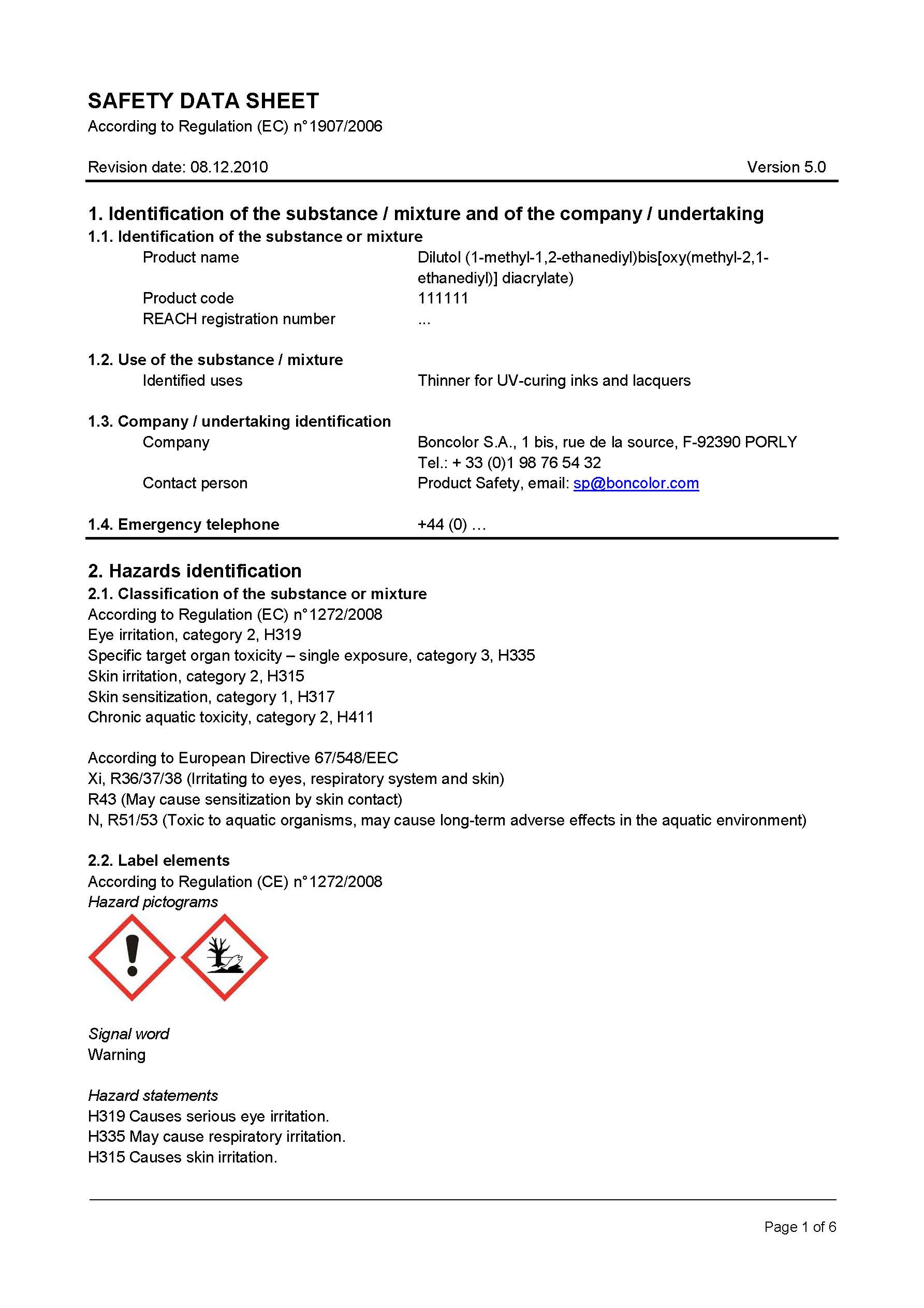
A key information source for the risk assessment is the safety data sheet (SDS) in its up-to-date version. The SDS must be provided to the user by the chemical supplier[1].
Further information can be collected from chemical suppliers and prevention institutes or organisations
It is important to note that both requirement analysis and risk assessment need to be repeated on a regular basis and whenever a change is introduced in the storage facility or following any abnormal occurrence (incident, accident, health issue). As a result, new preventive measures may have to be defined.
Figure 1: A safety data sheet
In addition to the specifications, the chemical storage facility must also align with general prevention principles with regard to location, construction and equipment.
Figure 2: Examples of prohibitive, warning and mandatory signs relative to chemicals from European Directive 92/58/EEC, annex II

The chosen location should sit on stabilised ground and be protected from flood waters. As far as possible it should be located on ground level.
In principle, the chosen location must be solely dedicated to chemical storage. However, if necessary, small quantities of chemicals can be stored in workshops and work areas provided a designated storage area is available., This could be an appropriate, ventilated chemicals storage cabinet, with an exhaust duct leading outside. A risk assessment must be carried out for the set-up of this designated storage area.
Furthermore, the chemical storage must be clearly indicated. Associated hazards must be clearly identified, for instance through appropriate warning signs. The personnel must also be informed about safety requirements before entering the storage location.
All building materials must be chemically resistant, particularly to the substances stored within the facility. Flooring must be damp- and chemical-proof. Moreover, in order to avoid contact with hazardous substances all surfaces should be easy to clean. At the same time, slip resistant flooring helps to prevent occupational accidents caused by falls. Storage facilities should also be constructed of non-combustible materials to avoid dissemination of hazardous chemicals, in case of fire.
First of all, access to the chemical storage facility should only be allowed to authorised personnel by putting in place measures to control access.
Furthermore, access to the facility and its alleyways must be large enough and designed according to the activities carried out (e.g. use of handling equipment). In case of emergency, the rescue teams must also be able to access the storage facility quickly. Therefore, stairs and steps close to the entrance of the facility should be avoided.
The number of emergency exits depends on the facility size and configuration. Escape doors must be designed in such a way that they open to the outside and that they can be opened easily from the inside without the use of any key (e.g. providing panic bars). Also, both alleyways and escape routes must be clearly signalled.
Any leakage or spill must be contained, so that it does not mix with other chemicals or reach the sewers. Chemical storage bunds are containment systems to prevent spills of hazardous liquids from leaking away. The type and capacity of the chemical storage bunds depend on the nature and volume of the stored chemicals. Suitable absorbents (neutralising or incombustible) should be readily available in case of small leakages; information on such absorbents can be found under heading 6 ‘Accidental release measures’ of the safety data sheet (SDS).
In the event of a fire, it is important to prevent extinguishing water from entering the sewer system. Therefore, the installation of a specific drainage system is recommended.
To prevent the accumulation of hazardous vapours, the storage facility must be ventilated, with the air renewal rate adapted to the stored chemicals and the activities carried out in the facility. Air inlet and outlet should be placed to avoid any ‘dead’ zone.
Moreover, if frost or heat can damage products and packaging, and appropriate heating and air conditioning must be installed. Information on temperature sensitivity is available in the safety data sheet (SDS) under heading 7 ‘Handling and storage’.
In addition to these requirements, the whole facility must be sufficiently illuminated, so that labelling can be easily read, and damaged packaging or abnormal occurrences can be detected in time.
Storage racks or cabinets must be chemically resistant. They should also be made from incombustible material to prevent the escalation of an incident and the spread of a fire.
Particular attention must be paid to the maximum load of racks and cabinets. The mechanical resistance of the storage systems must be adapted to the stored goods. In addition, the storage system configuration must prevent any tilting of the containers.
Furthermore, it must be easy to place and remove the chemicals from storage. Therefore, suitable handling equipment must be made available, as necessary.
To limit the impact of a fire, preventive measures must be taken, especially when the storage facility contains combustible or toxic material. Such measures include:
Moreover, combustible gases, combustible dust or flammable liquids can form an explosive atmosphere when they are released from their packaging. When such chemicals are stored, additional measures are necessary such as:
Technical preventive measures are of prime importance for a safe chemical storage. For the protection of workers, the general public and the environment, however, they need to be supplemented by organisational preventive measures.
The employer has a legal responsibility to protect the health and safety of his/her staff and the environment. He/she must thus assess the risks associated with the chemical storage facility, implement the appropriate preventive measures, control their effectiveness on a regular basis and ensure their maintenance.
In this context the employer must inform his/her staff about the risks and preventive measures and provide them with relevant training, including, among others, the following rules of conduct:
The larger the stored volumes, the greater the hazard. Moreover, unused chemicals become chemical waste, which generates additional risks. As a result, stock must be minimised in accordance with the organisation’s activities, and a ‘first in, first out‘ rule must be observed.
Without proper packaging, labelling and an up-to-date safety data sheet (SDS) a chemical should not be accepted in the storage facility. There may be exceptions to this rule. For example, SDS are not obligatory for products only intended for the general public but all relevant safety information must be included directly on the label.
Chemicals should be stored in their original container. However, if a transfer is necessary, the chemical should be transferred to a suitable container that is properly labelled. The container should be chemically, mechanically and thermally resistant, and easy to handle and store using existing equipment and systems.
Maximum loads of storage systems must be respected as well as stacking rules. Moreover, containers should be stored in such a way that their labelling can be easily read and that a leakage or damage can be easily seen and dealt with quickly.
Figure 3: Close-up on heading “10. Stability and reactivity” of a safety data sheet
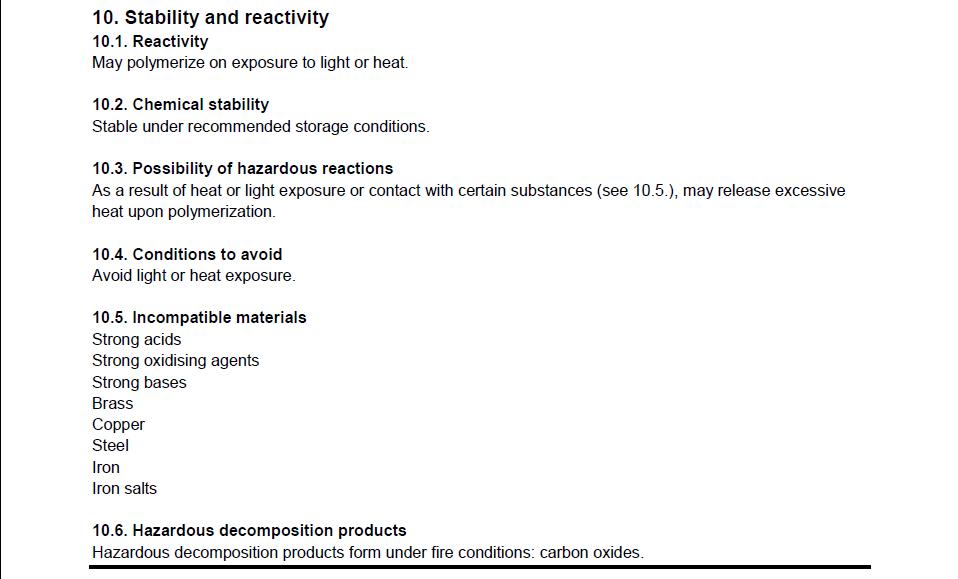
Some chemicals can react hazardously together, causing harmful emissions, radiating heat, fire or explosions. In case of a leakage they must not come into contact with each other. Depending on the stored volumes, separation can mean placing these incompatible chemicals on different containment basins or in different walled sections of the facility.
Such incompatibilities are usually described under headings 7 and 10 (‘Handling and storage’ and ‘Stability and reactivity’, respectively) of the SDS1. OSH institutes or organisations can also provide useful information about the reactivity of specific substances.
Finally, in event of an accident, staff must react quickly and appropriately. The employer must therefore draw up emergency procedures, provide emergency and first aid equipment, and inform and train workers.
Emergency procedures include:
On top of safety training, evacuation drills must be organised regularly and first-aiders must be appointed and trained.
Furthermore, it is recommended to keep an up-to-date inventory of all stored products. The inventory should include information about the products, their quantities and their location in the storage facility and it should be made available to emergency workers. In addition, regular consultation with the local fire and rescue authorities will help emergency services to take appropriate action in case of emergency.
[1] INRS, La fiche de données de sécurité, 2022. Available at: https://www.inrs.fr/media.html?refINRS=ED%206483
EU-OSHA – European Agency for Safety and Health at Work, Dangerous substances e-tool. Available at: https://osha.europa.eu/en/tools-and-resources/e-guides/dangerous-substances-e-tool
EU-OSHA – European Agency for Safety and Health at Work. Practical tools and guidance on dangerous substances. Available at: https://osha.europa.eu/en/themes/dangerous-substances/practical-tools-dangerous-substances
Téma kiválasztása